Table of Contents >> Show >> Hide
- Why Chameleons Are Basically Built to “Hold My Drink”
- So… Will They Really Hold Onto Anything?
- The Viral Part: Why Watching It Is So Ridiculously Funny
- How to Offer a Chameleon Something to Hold (Without Being “That Person”)
- Reading the Room: When “Holding Things” Means “I’m Stressed”
- Better Than Random Objects: Give Them Great Stuff to Hold in Their Habitat
- Wild Chameleons: Enjoy the Meme, Don’t Make It a Challenge
- Real-World “They’ll Hold Anything” Experiences (The Extra You Came For)
- Conclusion: The Internet Didn’t Invent ThisIt Just Finally Noticed
Every once in a while, the internet discovers a “new” animal fact that’s been true since foreverlike
how ducks have opinions, or how cats can turn liquid when a cardboard box is involved.
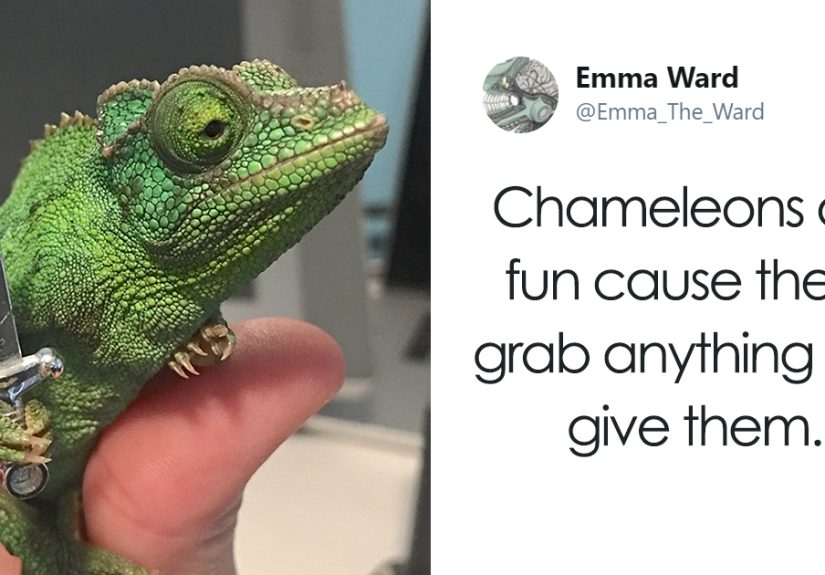
Today’s episode: someone realizes chameleons will politely grab pretty much anything you offer,
and suddenly we’re all emotionally invested in a tiny dinosaur doing the world’s gentlest handshake.
It looks like a prank, but it’s actually just peak chameleon engineering. Hand them a twig? They clamp it.
A pen? Sure, that’s a branch now. Your finger? Congratulations, you’ve been promoted to “portable tree.”
The funniest part is how seriously they take the assignmentlike they’re clocking in at the “Holding Things
Department” and they do not want to disappoint their manager.
Why Chameleons Are Basically Built to “Hold My Drink”
Chameleons aren’t being clingy for the comedy. Most species are arborealmeaning they spend a whole lot of
life in trees and shrubsso survival depends on one core skill: staying attached to whatever they’re on.
Falling isn’t “oops,” it’s “injury,” and nature tends to reward creatures that can avoid gravity-related drama.
Those mitten-looking feet aren’t cute by accident
Chameleon feet are famous for looking like tiny salad tongs. Each foot has toes bundled into two opposing
groups (commonly a 2-and-3 split), creating a clamp that grips branches with surprising control. Their toes
function a lot like our thumb-and-finger pinch, except it’s optimized for bark, twigs, and uneven surfaces.
Add sharp claws, and you get a reptile that can lock onto perches with the confidence of someone gripping a
subway pole during a sudden stop.
And then there’s the prehensile tail: the original extra hand
Many chameleons also have a prehensile tailmeaning it can wrap around and grasp objects. In the wild, this
tail is a stability tool: it anchors them when reaching, climbing, or navigating skinny branches. It’s a
literal safety line that lets them lean forward without tipping into the void.
Put those two features togetherclamping feet plus a grippy tailand you have an animal that’s basically
designed to hold onto things. So when you offer a chameleon an object that feels like a perch, it often
reacts the way it evolved to react: by taking it seriously and securing the situation.
So… Will They Really Hold Onto Anything?
“Anything” is a funny exaggeration, but the behavior can feel that way because chameleons are wired to test
stability. If you present an item like you’re offering a branchsteady, horizontal-ish, and close enough to
step ontothey may wrap toes around it and settle in. It’s less “I love this pen” and more “I have determined
this is a safe surface and I will now become one with it.”
Objects that tend to get the best “chameleon grip response” usually share a few traits:
- Branch-like shape: slender, cylindrical, or uneven in a natural way.
- Non-slippery texture: matte, slightly rough, or warm enough not to feel weird.
- Predictable movement: held still so the chameleon can step on at its own pace.
Meanwhile, objects that often get rejected are smooth, cold, slippery, vibrating, sticky, or moving too fast.
Chameleons are visual hunters with a strong “don’t surprise me” preference. If your offering feels like chaos,
they may respond with the reptile equivalent of a hard pass: backing away, flattening their body, changing color,
or opening their mouth to say, “No thank you, I’m busy being a leaf.”
The Viral Part: Why Watching It Is So Ridiculously Funny
The humor comes from the mismatch between the animal’s seriousness and the object’s absurdity. A chameleon
doesn’t grab your finger like a toddler seeking comfort. It grabs like a professional climber assessing
structural integrity. The vibe is: “This appears to be a stable support beam. I will now secure it with my
clamp-feet and proceed with my mission.”
It also doesn’t hurt that their movements are slow, deliberate, and oddly polite. They don’t snatch. They
place. They don’t panic. They evaluate. Their hands look like they’re wearing tiny oven mitts,
and yet they operate those mitts with more precision than many people have when opening a bag of chips.
How to Offer a Chameleon Something to Hold (Without Being “That Person”)
If you’re watching these clips and thinking, “I want to try this,” the most important rule is simple:
don’t force it. Chameleons aren’t toys, and a stressed chameleon can get sick, stop eating, or injure itself
trying to escape. The goal is to let the chameleon choose, every time.
Do: treat your hand like a branch
- Move slowly and keep your offering steady.
- Position the object below or in front of the chameleon’s current perch.
- Let it step on when it’s readyno pushing, no pulling, no “come on, just do it for the video.”
Don’t: peel a chameleon off its perch
One of the most common mistakes is trying to yank a chameleon off a branch when it’s gripping hard. That can
injure toes, nails, or the tail. If a chameleon is holding on, it’s communicating, “This is my safety.”
Respect the grip and gently encourage it to step forward instead.
Do: keep handling minimal and hygienic
Many reputable care guides recommend limiting handling because chameleons can be stress-prone. And because
reptiles can carry germs like Salmonella, handwashing before and after is a smart baseline. If kids are involved,
supervision matters even more.
Reading the Room: When “Holding Things” Means “I’m Stressed”
Here’s the nuance people miss when they only see the cute clips: gripping can look the same whether the
chameleon is calm or anxious. A chameleon might clamp down because it’s comfortable… or because it feels insecure
and is trying not to fall while it figures out what’s happening.
Common “please stop” signals
- Gaping mouth: an open-mouth display can be a threat response, not a joke.
- Hissing or puffing up: classic “back off” messaging.
- Dark, intense coloration: sometimes linked with stress (context matters by species).
- Rocking or rapid repositioning: trying to escape without sprinting.
- Refusing food afterward: a big red flag that the interaction was too much.
If you see those signals, the “fun experiment” is over. Let the chameleon return to its enclosure, lower stimulation,
and try again another dayif at all.
Better Than Random Objects: Give Them Great Stuff to Hold in Their Habitat
If your end goal is a happy, thriving chameleon, the best “holding things” plan isn’t handing them household items.
It’s building a habitat that feels like a three-dimensional jungle gym: safe branches, varied diameters, sturdy live
plants, and proper environmental conditions.
Perches that feel natural
Think branches of different thicknesses, positioned so the chameleon can move without risky leaps. The more stable
the environment, the less a chameleon has to “white-knuckle” grip everything for dear life.
Humidity, hydration, and comfort
Many chameleons rely on appropriate humidity and regular misting or drip systems for hydration. When the habitat is
dialed in, they’re typically calmer, more confident moversand much less likely to act like they’re clinging to their
last paycheck.
Wild Chameleons: Enjoy the Meme, Don’t Make It a Challenge
In some places, chameleons exist in the wild because they’re native; in other places, they’re there because they were
introduced via the pet trade. Either way, the “let me hand you a toothbrush” impulse is not great for the animalor
the ecosystem.
In the United States, there are documented situations where nonnative chameleons have established populations (for
example, Jackson’s chameleons in Hawaiʻi and introduced chameleons in Florida). That’s a complicated conservation story
involving escaped or released pets, local wildlife impacts, and ongoing management concerns. The takeaway for a casual
observer is simple: don’t handle wildlife, don’t relocate animals, and don’t turn a living creature into content.
Real-World “They’ll Hold Anything” Experiences (The Extra You Came For)
If you spend enough time around chameleonswhether as a keeper, a veterinarian, or a careful pet owneryou start to
see why this behavior is such a crowd-pleaser. The funniest “holding” moments are usually the ones that happen
accidentally, when a chameleon calmly applies its branch-logic to something that is technically not a branch.
One common scenario: enclosure maintenance. You open the door to mist plants or adjust a vine, and your chameleon
spots the tool you’re using. A spray wand, a thermometer probe, a feeding cup handleanything long and steady can
register as a potential perch. If the chameleon is confident, it might reach out with one mitten-foot, clamp down,
and test it like an engineer doing quality assurance. If it passes the test, it steps on. If it fails (wiggles too
much, feels too cold, moves unpredictably), you’ll see a slow, offended withdrawallike it’s quietly judging your
construction skills.
Another classic is the “hand as a bridge” moment. A chameleon wants to move from one branch to another, but the gap
is awkward. You place your hand nearby, not grabbing, just offering a stable platform. The chameleon reaches, grips,
and then pauses. This pause is everything. It’s the tiny internal meeting where it decides whether you are:
(A) a reliable tree, (B) suspicious furniture, or (C) an unlicensed predator in a skin suit. When it chooses A, the
step that follows feels ridiculously ceremonialslow motion, full commitment, and a grip that says, “I have accepted
your application.”
People also notice that chameleons can be hilariously “literal” about stability. They’ll hold onto a branch and then
add the tail as a backup anchor, even when it seems unnecessary. To us, it’s overkill. To them, it’s standard safety
protocol. Sometimes they’ll wrap the tail around a perch and then reach forward, looking like a tiny trapeze artist
doing a one-reptile circus act. It’s not showboatingit’s just how they keep balance while moving their body weight
in careful increments.
Then there are the moments that teach you respect for the grip. A chameleon that decides “this is my perch” can hold
on with surprising determination. That’s why experienced keepers emphasize never pulling them off a branch. Instead,
you let them step forward, or you gently encourage movement by placing an alternate perch in front of them. The humor
of “they’ll hold anything” is best enjoyed when the chameleon is the one choosing the interaction, because that grip
is part of how they feel safe.
Finally, the most wholesome “holding” experience is watching a chameleon relax into a stable environment. When the
enclosure has the right perches, good cover, and consistent conditions, they move with more confidence. Their grip
looks less like panic and more like purposeful climbingone foot placed, toes clamped, weight shifted, tail used
like a seatbelt. It’s a reminder that the funniest animal behaviors often come from real adaptations. The joke isn’t
that the chameleon is weird. The joke is that evolution built a creature so perfectly suited to gripping branches
that it can’t help but treat your pencil like a legitimate piece of infrastructure.
Conclusion: The Internet Didn’t Invent ThisIt Just Finally Noticed
Chameleons “holding onto anything” is funny because it’s true and deeply practical. Their clamp-like feet and
(often) prehensile tails evolved for life in trees, and that same toolkit makes them look like tiny, serious-minded
professionals when they grab an object you offer.
Enjoy the clips, laugh at the mitten-hands, and appreciate the biology. If you interact with a chameleon in real life,
keep it gentle, minimal, and on the animal’s terms. The best punchline is a healthy chameleonsecurely holding onto
something that actually belongs in its world.