Table of Contents >> Show >> Hide
- What Does Zero Net Energy Actually Mean?
- Inside the Deerfield Barn: Rustic Meets High Performance
- Key Design Moves That Make a Barn Net-Zero
- The Role of Programs and Standards
- Living in a Net-Zero Barn: Comfort, Health, and Everyday Life
- Cost, Payback, and the Long View
- Design Takeaways from the Remodelista-Style Net-Zero Barn
- Real-World Experiences: What It’s Like to Do a Zero Net Energy Barn Renovation
- Conclusion
Picture an old New England barn: weathered boards, creaky beams, that faint smell of hay
and history. Now imagine the same barn quietly powering itself with sunshine, sipping so
little energy that the utility bill is basically a polite suggestion instead of a demand.
That, in a nutshell, is the magic of a zero net energy barn renovation.
The Remodelista-featured Zero Net Energy Barn Renovation in Deerfield, Massachusetts,
designed by Catherine Truman Architects, is a perfect example. The project kept the heavy
timber frame and rustic character while layering in serious building science: insulated
envelopes, high-performance windows, and a solar array on the roof that offsets the
building’s annual energy use. It’s part guest house, part design crush, and part energy
nerd’s dream.
In this guide, we’ll walk through what “zero net energy” actually means, how a barn
conversion can realistically hit that target, and what you can borrow from case studies,
national energy programs, and real-world projects to make your own renovation smarter,
healthier, and far more efficient.
What Does Zero Net Energy Actually Mean?
“Zero net energy” (often shortened to ZNE or “net-zero”) doesn’t mean a building never
uses energy. Instead, it means that over the course of a year, the building produces at
least as much energy as it consumes. A typical path looks like this:
- First, radically reduce energy demand through efficiency and good design.
- Then, add on-site renewable energyusually solarto cover the remaining needs.
The U.S. Department of Energy’s Zero Energy Ready Home program describes this as a
high-performance approach: the building is efficient enough that a reasonably sized solar
system can offset most or all annual usage.
For barns, that definition is especially interesting. You’re dealing with big volumes,
old structures, and often very leaky building envelopes. Hitting net-zero in that context
means taking a building that was originally designed for hay and horses and upgrading it
for high comfort and ultra-low energy use without losing the soul of the place.
Inside the Deerfield Barn: Rustic Meets High Performance
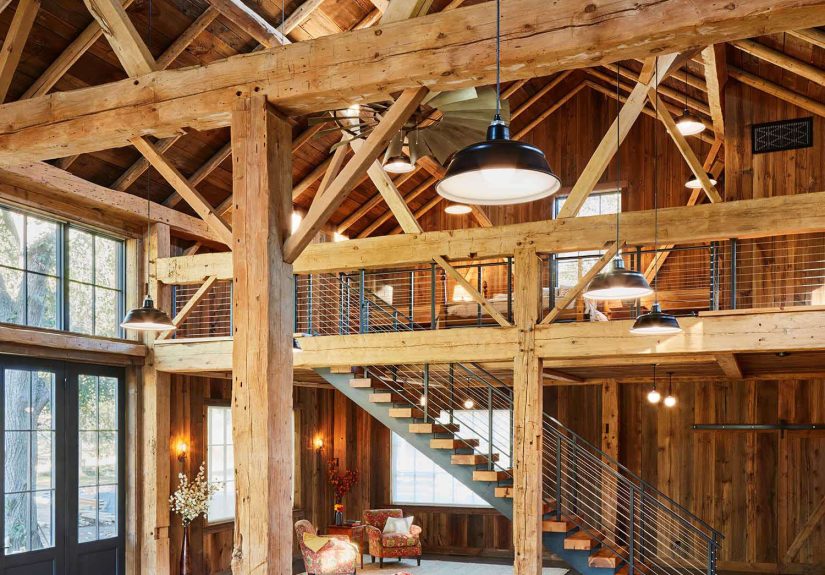
The Deerfield zero net energy barn renovation is set in Massachusetts and uses an existing
heavy-timber barn as a shell for a new guest space. The design keeps the open barn feel:
a large dining and living area tucked under exposed trusses, rustic barn board on the
interior, and a cable-rail stair that keeps sightlines open. Black-framed windows and
doors add a modern touch against the weathered wood.
The charm is obvious, but the performance is quietly doing the heavy lifting. Solar panels
on the roof provide the renewable energy needed to meet net-zero goals, while hidden
upgrades in insulation, air sealing, and mechanical systems keep the barn comfortable
in New England’s hot summers and snowy winters.
This blend of old and newkeeping the authentic barn character while raising performance
to 21st-century standardsis exactly what makes the project so compelling. It proves that
“eco-friendly” doesn’t have to look like a spaceship; it can look like the classic barn
down the road… just with a much smarter roof.
Key Design Moves That Make a Barn Net-Zero
1. Super-Insulated, Airtight Envelope
Whether you’re renovating a barn or a ranch house, every net-zero building starts with a
high-performance envelope. Energy efficiency experts consistently highlight two priorities:
airtightness and high R-value insulation.
-
Roof and walls: Deep insulation in the roof and walls cuts heat loss in
winter and heat gain in summer. In barn conversions, this often means adding a new
insulated layer inside or outside the existing structure. -
Slab or floor: Insulating beneath or above the existing barn floor
helps stabilize temperature and reduces cold-floor complaints. -
Air sealing: Old barns are basically giant colanders. Strategic air
sealing with tapes, gaskets, and membranes turns that drafty structure into a tight,
well-controlled shell.
Many net-zero case studies show that envelope improvements alone can slash heating and
cooling loads by 40–60%, which then allows for smaller, more efficient mechanical systems
and a smaller solar array.
2. High-Performance Windows and Doors
In the Deerfield barn, black-framed windows provide a modern, minimal aesthetic, but their
performance matters just as much as their looks. Well-designed net-zero projects typically
rely on:
- Low-e, double or triple glazing for better insulation.
- Thermally broken frames to reduce conductive heat loss.
- Thoughtful placement to invite winter sun and limit summer overheating.
In a barn with large openings, the right glass keeps the interiors bright and connected to
the landscape without turning the space into a greenhouse in July or a freezer in January.
3. Efficient Heating, Cooling, and Ventilation
Once the envelope works, the mechanical systems can be elegantly simple. Many net-zero
homes now use:
-
Air-source heat pumps for both heating and cooling, taking advantage of
electricity that can be offset with solar. -
Heat- or energy-recovery ventilators (HRVs/ERVs) to bring in fresh air
without wasting the conditioned air you’ve already paid for. - Right-sized equipment tuned to the low loads of a super-insulated shell.
Studies of net-zero homes consistently show that these systems, when properly designed and
commissioned, deliver both comfort and lower operating costs compared with conventional
forced-air furnaces and oversized air conditioners.
4. Solar Panels on the Barn Roof
The icon of almost every net-zero project is the solar array, and the Deerfield barn is
no exception. The barn’s roof becomes a power plant, with photovoltaic panels converting
sunlight into electricity to offset annual consumption.
Key considerations for a barn roof solar array include:
- Orientation and tilt for optimal solar gain.
- Roof structure strong enough to handle panel loads.
- Simple wiring and inverter placement to minimize losses.
Some projects go a step further and use building-integrated photovoltaics (BIPV), where
the roof or façade itself doubles as the solar panel surface. While more specialized,
BIPV can be a powerful option for design-conscious projects.
The Role of Programs and Standards
You don’t have to reinvent the wheel to create a zero net energy barn. In the U.S.,
several programs and standards provide ready-made checklists and performance targets.
DOE Zero Energy Ready Home
The DOE’s Zero Energy Ready Home (ZERH) program sets stringent requirements for envelope
performance, mechanical systems, water efficiency, and indoor air quality. Homes that
meet the criteria are designed so that a renewable energy system can offset most or all
of their energy use.
Case studies in this program include barn-inspired homes and carriage houses, like the
Way Back Barn, a New York project that won a DOE innovation award. These projects show
that rural and semi-rural buildings can hit ZERH standards without sacrificing
character.
Regional and Utility Programs
Many states and utilities offer rebates or incentives for high-efficiency upgrades,
solar installations, and even full net-zero projects. In New England and across the U.S.,
these incentives can significantly reduce the upfront cost of:
- High-performance windows and doors.
- Heat pumps and advanced ventilation equipment.
- Solar panels and battery storage.
When you combine incentives with long-term energy savings, the financial case for a
zero net energy renovation starts to look much less like a luxury and more like a smart,
long-term investment.
Living in a Net-Zero Barn: Comfort, Health, and Everyday Life
The romance of a barn renovation is obviousexposed beams, tall ceilings, big windows,
maybe a long farm table that can handle Thanksgiving plus a small wedding. But net-zero
upgrades add some quieter benefits you feel every day.
-
Stable comfort: High insulation levels and airtight construction mean
fewer drafts, more even temperatures, and a barn that feels cozy instead of cavernous. -
Quieter interiors: The same envelope improvements that keep heat in
also reduce outside noise. -
Better indoor air quality: Mechanical ventilation with filtration
helps reduce pollutants, allergens, and moisture, which is especially helpful in
older, previously unconditioned structures. -
Predictable utility bills: Once solar is in play, energy bills become
much more stable and often dramatically lower over the year.
In other words, you get the romantic barn life without needing three sweaters and a
space heater to survive January.
Cost, Payback, and the Long View
It’s fair to ask: is a zero net energy barn renovation just an expensive flex?
The honest answer is: it depends on your starting point, your goals, and how
strategically you phase the project.
Most zero-energy case studies highlight four main cost levers: envelope work, mechanical
systems, appliances/lighting, and power production (solar). When you treat the building
as a system instead of as a series of disconnected upgrades, you can often:
- Downsize mechanical systems because the envelope is so efficient.
- Use efficient lighting and appliances to shrink the size (and cost) of the solar array.
- Capture incentives that offset part of the upfront investment.
The financial payback for a full net-zero renovation varies widely, but the value
isn’t just in the energy line of your budget. You’re also buying comfort, resilience,
and a building that’s better prepared for future energy codes and energy prices.
Design Takeaways from the Remodelista-Style Net-Zero Barn
If you love the Remodelista lookclean lines, honest materials, restrained color
palettesnet-zero design actually fits right in. Here are a few style and performance
lessons you can steal:
-
Let the structure shine: Expose heavy timber framing and original
barn boards, then tuck modern insulation and services behind simple drywall or
wood cladding. -
Use dark windows as a design anchor: Black-framed, high-performance
windows can make a strong modern statement while quietly meeting strict energy specs. -
Keep the palette calm, let the light do the work: White or neutral
interior finishes bounce natural light deep into the space, reducing the need for
artificial lighting during the day. -
Celebrate the roof as a design element: Treat solar panels as part
of the architecturealigned, well-integrated, and visually intentional.
The result is a barn that feels simple and serene, but performs like a little
environmental overachiever.
Real-World Experiences: What It’s Like to Do a Zero Net Energy Barn Renovation
Every glossy case study makes a net-zero barn look effortless, but anyone who has
actually pulled off a deep energy retrofit will tell you: there are some twists
in the road. Here are experience-based lessons and reality checks drawn from net-zero
projects across North America and from the broader zero-energy community.
1. Start with a Great Team, Not Just a Great Idea
The most successful projects almost always start with an architect and builder who
understand both historic structures and modern building science. In the Deerfield barn
renovation, the design team had to respect the existing timber frame while creating a
super-insulated envelope around it. That kind of balancing act is easier when everyone
on the team speaks the same efficiency language.
Homeowners who’ve gone through the process often say their biggest early win was hiring
professionals who were already comfortable with blower-door tests, heat pump specs, and
solar production estimatesrather than trying to convince a purely conventional builder
to “try net-zero for the first time” on a complex barn.
2. Expect a Few Surprises Behind the Barn Boards
Old barns were not built to modern residential standards, and that’s putting it gently.
Once you open up the walls and roof, you may find irregular framing, missing bracing,
moisture damage, or creative “solutions” from decades past. From an energy perspective,
this can actually be an opportunity: if you’re already touching the structure, it’s the
perfect moment to add structural reinforcement, upgrade insulation, and design a clean
air barrier.
The flip side is budget. Many owners of net-zero renovations report that contingency
funds are not optional. When your goal is both safety and performance, you don’t want
to be forced into cutting back on insulation or ventilation just because the roof
framing had a surprise twist.
3. Comfort Changes How People Use the Space
A funny thing happens once a barn becomes truly comfortable: people move in. A space
that might once have been a seasonal guest room or occasional party spot can quickly
become a full-time office, studio, or in-law suite. Owners of net-zero barns often
report that they end up using the renovated space far more than they expectedbecause
it simply feels good to be in it year-round.
That extra use is one more reason to design carefully. Daylight, views, acoustics, and
interior finishes matter just as much as R-values. The more people love being in the
barn, the more they’ll appreciate the quiet comfort that the high-performance shell and
mechanical systems provide in the background.
4. Monitoring Becomes Weirdly Addictive
Many net-zero homeowners install simple monitoring systems to track energy usage and
solar production. If you’re even a little bit data-curious, watching the barn “earn
back” its energy each sunny day becomes strangely satisfying. You start to see patterns:
how much power the heat pump uses during a cold snap, what happens on a cloudy week,
how much energy the barn generates on a bright winter day with reflective snow.
This feedback loop is more than just a geeky hobby. It helps you fine-tune thermostat
settings, spot unusual spikes in consumption, and understand how the building responds
over the seasons. Over time, many owners find they can tweak usage patternslike
shifting laundry or dishwashing to sunny hoursto squeeze even more value from their
solar production.
5. Lifestyle Shifts Feel Natural, Not Punishing
Perhaps the biggest myth about zero net energy living is that it requires constant
sacrifice. In practice, most people find that once the building envelope and systems
are doing their job, the “behavior changes” are fairly minor. You might swap out a
few energy-hungry appliances, get used to LED lighting, or become more aware of
leaving things on standbybut you’re not living in the dark or freezing in a sweater
for the sake of the planet.
In a barn renovation, that balance is especially clear. You still get the dramatic
volumes, the exposed beams, the big windows, and the cozy gatherings. You just also
get low utility bills and the quiet satisfaction of knowing that your beloved old
building is pulling its weight in a climate-conscious future.
6. The Payoff Is Emotional as Much as Financial
Yes, the lower bills and improved resale value matter. But people who live in net-zero
buildings often talk just as much about pride and peace of mind. There’s something
uniquely satisfying about taking an old, drafty barn and turning it into a place that’s
both deeply rooted in local history and aligned with modern sustainability goals.
That emotional payoff might not appear on a spreadsheet, but it’s real. When you walk
into a sunlit, warm, quiet barn that’s running mostly on the power of its own roof,
you feel it. It’s the same old buildingbut now it’s also a small, elegant piece of
the energy transition.
Conclusion
A zero net energy barn renovation, like the Remodelista-featured project in Deerfield,
shows what happens when timeless architecture meets thoughtful engineering. By combining
a tight, well-insulated envelope with efficient systems and a well-designed solar array,
you can transform a leaky relic into a comfortable, low-carbon, high-style living space.
Whether you’re planning your own barn conversion or just dreaming for now, the core
lessons are the same: start with performance, respect the original structure, and let
renewable energy do the quiet work on the roof. The result is more than a pretty
renovationit’s a building that’s ready for the future.