Table of Contents >> Show >> Hide
- Where the Titanic Wreck Lies
- How the Titanic Wreck Was Found
- What the Wreck Looks Like Today
- Why the Titanic Wreck Keeps Deteriorating
- The Titanic Wreck as a Scientific Site
- Digital Scans Changed the Conversation
- Why the Titanic Wreck Is Protected
- What the Titanic Wreck Still Teaches Us
- Conclusion
- Experiences Related to the Titanic Wreck
- SEO Tags
Some shipwrecks are famous because they are old. Some are famous because they are mysterious. And then there is the Titanic wreck, which somehow manages to be old, mysterious, tragic, cinematic, and scientifically fascinating all at once. More than a century after the RMS Titanic sank in the North Atlantic, the wreck still grips the public imagination like a cold hand on a ship’s rail.
But the Titanic wreck is more than a dramatic underwater postcard. It is a deep-sea archaeological site, a maritime memorial, a scientific laboratory, and a cultural symbol that keeps changing as the ocean slowly works on it. Every expedition, map, and digital scan has added new detail to the story. At the same time, every year the wreck becomes a little more fragile, a little more ghostly, and a little more urgent to document.
That tension is what makes the Titanic wreck so compelling. It is both preserved and disappearing. It is frozen in history, yet still in motion. And yes, it remains one of the few places on Earth where people can say, with perfect honesty, “The view is unforgettable, but please do not touch anything.”
Where the Titanic Wreck Lies
The Titanic wreck rests in the North Atlantic Ocean, southeast of Newfoundland, at a depth of roughly 12,500 feet. That is far below sunlight, far below ordinary diving limits, and deep enough to make the site feel almost extraterrestrial. The pressure at that depth is immense, which helps explain why reaching the wreck has always required highly specialized technology.
The wreck is not sitting on the seabed as one neat, intact ship. Instead, it lies in two major sections: the bow and the stern. The bow remains the more recognizable half, still carrying much of the ship’s haunting profile. The stern, by contrast, is a mangled tangle of steel, crushed by the violence of the sinking and the chaotic descent to the ocean floor. Around both sections stretches a broad debris field scattered with objects from the ship and from the lives of the people who were aboard.
That debris field is one reason the Titanic wreck continues to matter so much to historians and marine archaeologists. It does not simply show where the ship ended up. It helps experts reconstruct how the ship broke apart, how the sections sank, and how thousands of objects were carried, dropped, twisted, or buried along the seabed.
How the Titanic Wreck Was Found
For decades, the exact location of the Titanic remained one of the great unanswered questions of maritime history. That changed in 1985, when a joint expedition led by Woods Hole Oceanographic Institution in the United States and IFREMER in France finally located the wreck. Rather than searching only for the massive hull, the team followed a debris trail on the ocean floor. That strategy proved brilliant.
The breakthrough came when the expedition’s imaging systems spotted one of Titanic’s boilers. Soon after, the wreck itself was identified. It was a landmark moment not just for Titanic research, but for deep-ocean exploration as a whole. The discovery showed what modern underwater imaging and remote survey technology could accomplish in one of the harshest environments on the planet.
The story of the discovery has become legendary for good reason. It combined engineering, patience, historical detective work, and a little bit of human stubbornness. In other words, it was exactly the sort of effort you would expect for locating the most famous shipwreck in history.
What the Wreck Looks Like Today
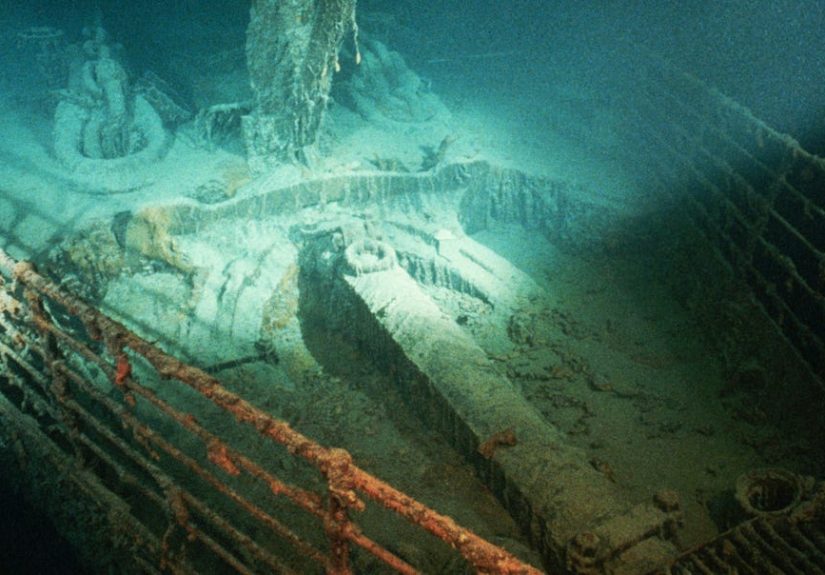
The bow section is the image most people recognize. Even after more than a hundred years underwater, it still looks unmistakably like Titanic. The railings, anchor area, and overall shape make it possible to identify the ship at a glance. But closer inspection reveals the cost of time. Metal has thinned, surfaces have buckled, and once-grand interiors have been damaged by collapse, corrosion, and deep-sea currents.
The stern is another story entirely. It is broken, twisted, and far less graceful than the bow. That is because the stern descended in a more violent state after the ship split during the sinking. As it fell, it likely rotated and came apart further, which helps explain why it looks less like a ship and more like the aftermath of a steel tornado.
Between and around these two main sections lies the debris field: dishes, fixtures, machinery, personal belongings, and structural fragments. These objects are not random clutter. They form patterns that reveal the physics of the disaster. The seabed, in effect, became a giant forensic map.
Why the Titanic Wreck Keeps Deteriorating
One of the most fascinating and sobering aspects of the Titanic wreck is that it is not merely rusting in a simple, everyday sense. The ship is being transformed by a complex underwater environment that includes corrosion, saltwater chemistry, ocean currents, sediment movement, and microbial activity.
Perhaps the most famous agents of decay are the “rusticles,” those eerie, icicle-like formations hanging from the metal. They look dramatic in photographs, but they are bad news for the ship itself. Rusticles host communities of microorganisms, including iron-eating bacteria, that contribute to the breakdown of the hull. In plain English, the ocean has recruited microscopic demolition crews.
This process is why the wreck’s appearance has changed over the decades. Features once clearly visible in earlier images have weakened, collapsed, or vanished. Railings have deteriorated, wooden elements have been consumed, and some interior spaces have become more exposed as surrounding structures fall away. The Titanic wreck still feels permanent in our imagination, but in reality it is temporary.
The Titanic Wreck as a Scientific Site
The wreck is not valuable only because it is famous. It is also one of the best-studied deep-ocean wreck sites in the world. Researchers have used Titanic to understand site formation, metal corrosion, microbial action, deep-sea ecology, and remote imaging methods. In that sense, the wreck has become a kind of underwater research campus, although admittedly one with much worse parking.
Mapping expeditions have been especially important. In 2010, researchers used advanced sonar, remotely operated vehicles, and imaging tools to create an archaeological map of the site with unprecedented detail. This allowed scientists to study how the bow impacted the seabed, how objects were distributed, and how the sinking unfolded spatially across the ocean floor.
The wreck has also taught researchers how technology can preserve knowledge even when the physical site is degrading. High-resolution mosaics, video documentation, and 3D imaging allow experts to compare changes over time. That means Titanic is not just being explored. It is being monitored.
Digital Scans Changed the Conversation
In recent years, digital documentation of the Titanic wreck has entered a new era. Large-scale scanning projects created a remarkably detailed “digital twin” of the wreck site, built from hundreds of thousands of images and extensive measurement data. The result is more than a visual spectacle. It gives historians, engineers, and marine archaeologists a way to study the ship as a whole rather than through the narrow window of a single submersible view.
That matters because visiting the actual wreck is difficult, expensive, risky, and limited by visibility. Traditional expeditions allow researchers to see only what is directly in front of the cameras or viewport at any given moment. A digital model, by contrast, makes it possible to analyze the entire site, revisit specific features, and compare structural clues without disturbing the wreck.
These scans may also help answer old questions about how Titanic broke apart and how each section descended. In other words, the wreck is still telling its story. It just seems to prefer doing so in 3D now.
Why the Titanic Wreck Is Protected
The Titanic wreck is not just an archaeological site. It is also widely treated as a memorial to the more than 1,500 people who died in the disaster. That ethical dimension shapes modern debates about how the site should be explored, recorded, and preserved.
U.S. law and international agreements have pushed policy toward respectful treatment of the wreck, with a preference for in situ preservation whenever possible. That phrase sounds technical, but the basic idea is simple: leave the site where it is, protect it, and avoid unnecessary disturbance. NOAA guidance and related legal frameworks emphasize careful research rather than reckless salvage.
This balance is not always easy. Public interest in Titanic is enormous, and artifacts recovered from the site have attracted crowds for years. But the strongest argument for restraint is that the wreck is not merely a source of collectible objects. It is a historical landscape, a gravesite, and a body of evidence. Pulling pieces out without context can damage the larger story.
What the Titanic Wreck Still Teaches Us
The Titanic wreck continues to teach lessons on several levels. Historically, it connects us to the 1912 disaster and to the investigations that followed, including the U.S. Senate hearings that examined ignored warnings, lifeboat shortages, speed, and emergency response. Those inquiries helped shape modern conversations about maritime safety and accountability.
Scientifically, the wreck shows how metal, microbes, and ocean conditions interact over long periods in extreme environments. Technologically, it has pushed advances in underwater imaging, mapping, and remote exploration. Culturally, it reminds us how certain tragedies become permanent reference points in the human imagination.
Most of all, Titanic endures because it sits at the intersection of story and evidence. It is a real place, not just a legend. The wreck exists in cold darkness, but it continues to illuminate questions about engineering, class, memory, loss, exploration, and the strange ways humans turn disasters into meaning.
Conclusion
The Titanic wreck remains one of the most powerful sites in maritime history because it is so many things at once: a technological challenge, an archaeological record, a memorial, and a cautionary tale. Found in 1985 and studied ever since, it has revealed details about the ship’s breakup, the spread of its debris, and the relentless forces that are slowly erasing it.
Yet the story is not ending quietly on the ocean floor. New imaging, mapping, and digital reconstruction are preserving the wreck in ways earlier generations could only dream about. Even as the actual ship weakens, the record grows richer. That may be the deepest irony of all: the Titanic wreck is vanishing physically while becoming clearer intellectually.
So when people talk about the Titanic wreck, they are not just talking about broken steel at the bottom of the Atlantic. They are talking about memory under pressure, history in fragments, and a ship that still has the rare power to make modern audiences stop, stare, and rethink what survival, loss, and discovery really mean.
Experiences Related to the Titanic Wreck
The experience of engaging with the Titanic wreck today is unlike reading about most historical events. It is emotional before it is intellectual. People may first encounter it through a documentary, a museum exhibit, a classroom lesson, or a dramatic image of the bow rising out of darkness. The reaction is often the same: awe, followed quickly by discomfort. The wreck is beautiful in a severe way, but it is also the aftermath of mass death. That combination creates a strange emotional tension that stays with people.
For museum visitors, Titanic exhibits often feel unusually personal. Seeing a recovered dish, a shoe, a letter, or a piece of the ship’s structure can collapse the distance between 1912 and the present. The disaster stops feeling like a giant abstract headline and starts feeling like a collection of interrupted lives. Even people who arrive expecting movie nostalgia often leave thinking less about Hollywood and more about human vulnerability. The wreck has that effect. It turns spectacle into reflection.
For researchers and historians, the experience is different but no less intense. They are not simply “looking at a wreck.” They are reading a site. The position of metal fragments, the condition of a railing, the spread of ceramics, the collapse of a deck section, all of it carries information. But the work also carries responsibility. Every image and measurement must respect the fact that the site is a memorial. That gives Titanic research a moral weight that many technical projects do not have.
There is also the modern digital experience of the Titanic wreck, which has become increasingly powerful. High-resolution scans and 3D models let people study the site in a way that older expedition footage never could. Instead of catching a few dim views through a camera light, audiences can understand the wreck spatially. They can see how the bow and stern relate to each other, how the debris field extends outward, and how much of the ship’s story is written across the seabed. It creates a feeling that is part exploration, part preservation, and part elegy.
Perhaps the most lasting experience connected to the Titanic wreck is the realization that history is not fixed. The site is changing. The ocean is still acting on it. Railings disappear, surfaces collapse, and bacteria continue their quiet work. That makes every expedition feel like a race against time. People are not just studying the wreck; they are documenting something that future generations may never see in the same condition again.
In the end, the experience of the Titanic wreck is not just about disaster. It is about attention. It asks people to slow down, to look carefully, and to hold two truths at once: human beings can build astonishing things, and human beings can lose them. That may be why the wreck remains so unforgettable. It does not simply show us the past. It shows us how fragile certainty has always been.