Table of Contents >> Show >> Hide
- What makes a “nuclear cruise missile” different?
- The legacy system: ALCM (AGM-86B) and the “it’s not getting younger” problem
- Meet LRSO: the “standoff” idea, upgraded for modern defenses
- The other half of the equation: the W80-4 warhead modernization
- How the LRSO program is being built: contracts, phases, and a lot of acronyms
- Why build a new nuclear cruise missile at all?
- The controversy: escalation, arms control, and the “blurry line” problem
- Where LRSO fits in the bigger modernization picture
- Quick FAQ for readers who want clarity without the classified annex
- Conclusion: a quiet system with loud strategic implications
- Experiences Around the LRSO (and Nuclear Cruise Missiles) of the Human Side
A nuclear cruise missile is the quiet kid in the strategic weapons yearbook: not as loud as an ICBM, not as
cinematic as a stealth bomber flyover, and definitely not something you want showing up uninvited. It’s a
long-range, self-powered missile that can fly a complex route and deliver a nuclear payloadbuilt for the
uncomfortable reality that deterrence is part technology, part psychology, and part “please never make us prove
this works.”
The United States’ next major nuclear cruise missile effort is the Long Range Stand Off (LRSO)
weaponoften described as a new stealthy, survivable replacement for the aging Air-Launched Cruise
Missile (ALCM). The details you’d love to know are (understandably) classified. But enough is public to explain
what LRSO is, why it exists, what it’s meant to do, how the W80-4 warhead modernization ties in,
and why this program sparks debates that can turn a budget hearing into a philosophical cage match.
What makes a “nuclear cruise missile” different?
Think of nuclear delivery systems as three different “problem-solving personalities.” Ballistic missiles are
direct: fast, high-arching, and hard to stop once launched. Bombers are flexible: they can be signaled,
repositioned, and even recalled. Cruise missiles occupy the in-between: they’re launched from an aircraft (or
ship/sub in other cases), then fly under their own power for long distances, following preplanned routes to
reach targets.
That “route” piece matters. A cruise missile can be designed to navigate around defenses rather than bulling
through them, and it can be launched from standoff distancemeaning the launch aircraft doesn’t have to enter
the most heavily defended airspace. This is why cruise missiles show up in conversations about
integrated air defense systems (IADS) and anti-access/area-denial (A2/AD):
the threat environment keeps evolving, and the U.S. wants options that remain credible in the face of that
evolution.
The legacy system: ALCM (AGM-86B) and the “it’s not getting younger” problem
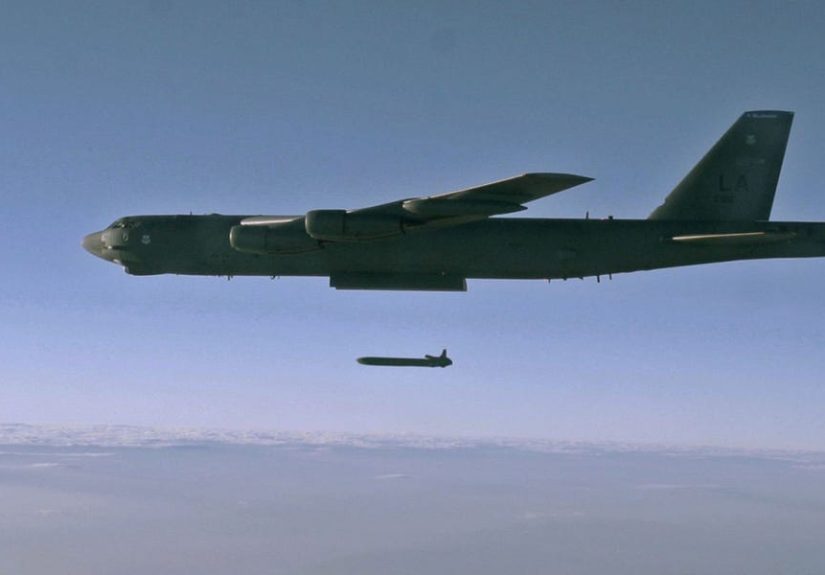
The current nuclear air-launched cruise missile in the U.S. arsenal is the AGM-86B ALCM.
Like a classic car, it has a certain historic swaggerbut it also has parts, electronics, and design assumptions
that were born in a different era. Public Air Force statements note that the ALCM was fielded in the early 1980s
with a much shorter original design life, and that it faces growing operational challenges as advanced air
defenses proliferate.
This is where the LRSO enters the chat. Not because anyone thinks nuclear weapons are “normal” tools (they are
not), but because the logic of deterrence is built on credibility. If a system can’t reliably get through the
defenses it might face, adversaries may start gambling that the threat is bluffor that the U.S. lacks usable
options short of the most extreme responses.
Meet LRSO: the “standoff” idea, upgraded for modern defenses
The LRSO is designed as a long-range, survivable standoff weapon intended to deliver nuclear effects on
strategic targets. In plain English: launch from a bomber, fly far, survive against advanced defenses, and hold
high-value targets at risk. That survivability typically implies a combination of low observability (“stealthy”
shaping/materials), smart routing, modern navigation, and resilient mission systemswithout public disclosure of
the sensitive specifics.
Why “standoff” matters
Standoff weapons change the geometry of risk. Instead of sending a bomber directly into the highest-threat zone,
the bomber can launch from outside the most dangerous rings of air defenses. The missile becomes the “forward
player,” while the aircraft preserves its survivability and flexibility. This concept is especially relevant for
older bombers that were never designed to be stealth aircraft, but still play a role in nuclear deterrence.
Which aircraft will carry it?
Public program documents indicate LRSO will be integrated on both legacy and future bomber aircraft. Program
reporting explicitly references integration objectives for the B-52 and B-21, and notes LRSO-to-B-52 integration
has been demonstrated via multiple captive-carry and release missionsan unglamorous but essential part of
turning a design into a real weapon system that works safely and consistently.
The other half of the equation: the W80-4 warhead modernization
A nuclear cruise missile is not just an airframe with aspirationsit’s a tightly coupled “missile + warhead”
enterprise. The warhead planned for LRSO is the W80-4, a life-extension program (LEP) derived from
the W80 family. The stated goal is to extend service life and improve safety, security, and reliability while
integrating with the new missile.
Modernization here is less “new magic” and more “high-stakes engineering.” Warheads involve complex production
and certification ecosystems, with different sites responsible for different components and processes. Public
NNSA materials describe the W80-4 program as supporting the bomber leg of the nuclear triad and enhancing
warhead safety and reliability. The program also emphasizes coordination between the Department of Energy/NNSA
and the Department of Defensebecause the warhead-missile interface is not the place you want “surprises.”
Schedule signals: what we can responsibly say in public
Public documents offer a few milestones that show the program’s pace and oversight tension. A GAO report
discussed NNSA’s schedule constraints and cited NNSA estimates about program cost and planned first delivery
timelineswhile also warning that official dates can be more aggressive than internal schedule risk analysis
supports.
More recently, official and lab communications highlighted progress on a key W80-4 subassembly milestone
(“first production unit” of a canned subassembly) at Y-12 ahead of schedule, and noted expectations for the
first completed W80-4 warhead in the 2027 timeframe. These kinds of updates matter because strategic systems
are not “one program”they’re a synchronized relay race. If one runner trips, everyone behind them has to
adjust stride.
How the LRSO program is being built: contracts, phases, and a lot of acronyms
If you’ve ever wondered how a major weapons program moves from “idea” to “fielded system,” LRSO is a perfect
examplemostly because it comes with enough acronyms to qualify as a dialect.
Technology maturation and risk reduction (TMRR)
In 2017, the Air Force awarded technology maturation and risk reduction contractspublicly described as
approximately $900 million each with an approximate 54-month period of performanceto two major defense
contractors. The idea is straightforward: mature designs, reduce technical uncertainty, and then downselect for
the next phase.
Engineering and manufacturing development (EMD)
In 2021, the Air Force announced an EMD contract award for LRSO to Raytheon. The public announcement described
the contract as about $2 billion, with work expected to be completed in early 2027. EMD is where the program
transitions from “we think this will work” to “we’re proving it works, can be manufactured, can be integrated,
and can be sustained.” It’s also where cost and schedule realities show up like a surprise pop quiz.
Budget and cost reporting: what the public documents show
Modernized Selected Acquisition Reports (MSARs) provide publicly released snapshots of acquisition cost
categories and unit cost metrics (with some quantities and performance details restricted). Recent MSAR
reporting includes base-year and then-year estimates across RDT&E, procurement, and total acquisition costs,
illustrating the scale of the program and how program reporting separates “today’s dollars” from “constant
dollars” for comparison.
Here’s the important interpretation: LRSO isn’t “just a missile.” It’s a program with development, procurement,
integration, training, support equipment, and long-term sustainment considerationsplus the parallel warhead
effort. If you only look at one line item, you’re basically judging a restaurant by the cost of salt.
Why build a new nuclear cruise missile at all?
Supporters generally argue that a survivable standoff nuclear cruise missile strengthens deterrence by ensuring
the bomber leg can hold targets at risk even when air defenses improve. They also point to the bomber force’s
flexibility: bombers can be generated, signaled, dispersed, and recalledoptions that don’t exist once a
ballistic missile is launched.
Another argument is “risk management.” If one leg of the nuclear triad faces unexpected technical trouble or
adversary breakthroughs, a robust bomber and standoff missile capability can provide resilience. And from a
force-planning perspective, adversaries must account for cruise missiles in their air defense investments, which
can impose costs and complicate planning.
The controversy: escalation, arms control, and the “blurry line” problem
Critics raise a different set of concerns, and they’re not lightweight. One theme is escalation risk: a stealthy
cruise missile is, by nature, hard to detect and can resemble conventional systems in some respects. Opponents
worry this ambiguity could increase miscalculation in a crisisespecially if an adversary can’t quickly tell
whether a launched cruise missile is nuclear-armed.
Another theme is strategic necessity and cost: if bombers and ballistic systems already provide credible
deterrence, why add (or sustain) another nuclear delivery system? Organizations focused on arms control have
argued that new nuclear cruise missile investments could undermine nonproliferation goals or complicate future
arms control negotiationseven if supporters argue the opposite (that modernization strengthens deterrence and
bargaining power).
A helpful way to read the debate is to see it as a disagreement about what “credible deterrence” requires in a
future environment: more flexible options that can penetrate defenses, or fewer systems that reduce ambiguity
and the risk of rapid escalation.
Where LRSO fits in the bigger modernization picture
LRSO is not happening in a vacuum. It’s one thread in a broader modernization effort spanning delivery
platforms, command and control, and warhead life-extension programs. Congressional materials summarize how
modernization touches all legs of the nuclear triad and cite large projected costs over a 10-year window.
In that context, LRSO is best understood as the “standoff upgrade” for the bomber leg: a way to maintain an
air-delivered option that remains credible against evolving defenses. Whether you view that as essential
insurance or an unnecessary complication depends on how you weigh deterrence theory, escalation dynamics,
budget constraints, and the future threat environment.
Quick FAQ for readers who want clarity without the classified annex
Is LRSO the same thing as a conventional cruise missile?
The basic flight concept is similarpowered, long-range, route-following. The mission, integration requirements,
security, and surety standards for a nuclear system are far more stringent, and many technical specifics are not
publicly disclosed.
Does “stealth” mean invisible?
No. “Low observable” design generally aims to reduce detection range and complicate tracking, buying the missile
time and survivability. It’s not magicmore like making it harder for an opponent’s sensors and systems to do
their jobs.
When will it be operational?
Public documents discuss development and integration progress, but exact timelines for operational fielding are
not consistently presented in unclassified detail. The public record does show active testing and integration
work and outlines acquisition phase milestones.
Conclusion: a quiet system with loud strategic implications
Nuclear cruise missiles are, in a sense, deterrence’s “long paragraph”: complicated, carefully constructed, and
only useful if nobody ever forces you to read it out loud. The LRSO is intended to replace an aging legacy
system and keep the bomber leg credible against advanced defenses. Its companion warhead, the W80-4, illustrates
how modernization is as much about safety, reliability, and industrial coordination as it is about new
capability.
Whether you see LRSO as necessary modernization or risky redundancy, the program sits at the intersection of
technology, strategy, and politicswhere every design choice has a budget line, and every budget line has a
worldview attached. That’s why the LRSO isn’t just a missile story. It’s a story about what the United States
believes deterrence will require in the decades ahead.
Experiences Around the LRSO (and Nuclear Cruise Missiles) of the Human Side
“Experiences” in the nuclear cruise missile world aren’t about joyrides or test-driving a concept car. They’re
about long timelines, meticulous process, and a culture that treats small details the way a surgeon treats
sterility: non-negotiable. If you want to understand LRSO, it helps to picture the people and routines that sit
behind the acronyms.
Start with the test and integration crews. The public record mentions captive-carry and release
activitiesthose are the kind of workdays where success looks boring on purpose. A bomber carries an inert or
test article, engineers collect telemetry, and everyone obsesses over vibration, separation dynamics, and
interface behavior. Nobody wants drama; drama is a synonym for “write a 200-page report and explain it to
Congress.” The most celebrated moment might be a clean data plot and a flight crew saying, “Yep, handled like it
should.”
Then there are the maintainers and load crews, whose “experience” is equal parts technical skill
and procedural discipline. Nuclear surety culture is checklists layered on checklists, with the quiet
understanding that the checklist is undefeated. In public program descriptions, training requirements cover
missile maintenance, weapons load crews, warhead maintenance, aircrew, mission planners, and even EOD
personnelbecause the system has to be handled safely across its entire lifecycle, not just at the moment of
launch. It’s a community where “slow is smooth, smooth is fast” stops being a slogan and becomes a lifestyle.
On the warhead side, the “experience” often sounds like manufacturing meets science fiction. Multiple sites
produce different components, and everything must fit together with extremely tight tolerances. Lab teams talk
about qualification testing for vibration, shock, and thermal environments, and about building test units to
verify performance while refining manufacturability. That is the emotional arc of a modernization program:
relentless verification, constant coordination, and a very specific type of pride when a milestone is met ahead
of schedulebecause meeting schedule without compromising safety is the whole point.
Finally, there’s the public-policy experience, which is basically a group project where half the
class wants to add features and the other half wants to delete the assignment. Analysts, lawmakers, and
advocates argue about deterrence, escalation, and arms control with genuine seriousnessand sometimes with the
kind of rhetorical heat usually reserved for sports rivalries. If you’ve ever watched a hearing clip or read a
debate memo, you’ve seen how a single phrase like “credible options” can mean “essential insurance” to one side
and “dangerous ambiguity” to the other. LRSO lives in that tension: a technical program shaped by strategic
theory, budget reality, and the human need to reduce uncertainty in an uncertain world.