Table of Contents >> Show >> Hide
- Why Letter Format Still Matters
- The Standard Parts of a Formal Letter
- Letter Format Example
- How to Write a Letter That Actually Works
- Letter Writing Tips for Different Situations
- Common Letter Format Mistakes to Avoid
- Mailing Tips for Printed Letters
- Real-World Experience: What Writing Letters Teaches You
- Final Thoughts
Some people hear the word letter and immediately picture old-timey parchment, a fountain pen, and somebody dramatically signing their name before boarding a train. In reality, letters are still wildly useful. You need them to apply for jobs, request information, file complaints, say thank you, ask for favors, confirm decisions, and communicate professionally without sounding like a robot trapped in a word processor. A good letter format does more than make your page look tidy. It helps your reader understand who you are, why you are writing, and what should happen next.
If you have ever stared at a blank page wondering where the date goes, whether “Dear Sir or Madam” still belongs in this century, or how to sound polished without writing like a Victorian attorney, you are in the right place. This guide walks through a practical letter format example, explains the parts of a strong letter, and shares writing tips that make your message clear, professional, and genuinely readable. No fluff. No weird jargon. No “per my previous pigeon.”
Why Letter Format Still Matters
A strong letter format does two jobs at once. First, it creates structure. Your reader can quickly spot the sender, recipient, greeting, message, and closing. Second, it builds credibility. A neatly formatted letter suggests that you are organized, thoughtful, and serious about the message you are sending. That matters whether you are writing a business letter, a cover letter, a formal request, or even a carefully worded note to a landlord who still has not fixed the heater.
Professional letters also work because they slow you down in the best possible way. Unlike a rushed text message or an all-lowercase email written while eating chips over a keyboard, a letter encourages intention. You think about your purpose. You choose your tone. You decide what the reader needs to know and what should be left out. In short, you become a better communicator, which is a pretty good side effect for a single sheet of paper.
The Standard Parts of a Formal Letter
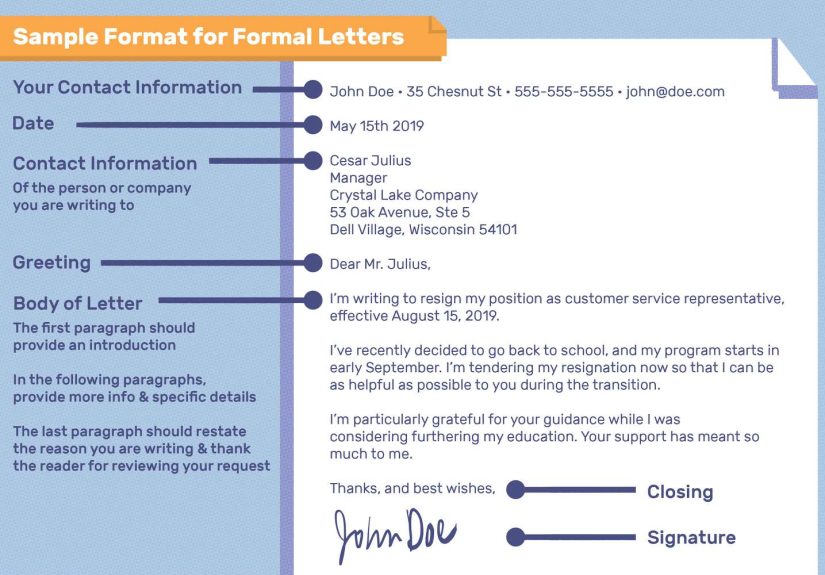
Most formal letters follow a classic structure. The exact style can vary slightly depending on whether you are writing a business letter, official letter, or cover letter, but the basic building blocks stay the same.
1. Sender’s Contact Information
This section identifies who the letter is from. It usually includes your full name, street address, city, state, ZIP code, and sometimes your phone number and email address. If you are using company letterhead, you may not need to repeat all of this information.
2. Date
The date should appear clearly near the top of the letter. In American English, the standard format is month, day, and year, such as March 7, 2026.
3. Recipient’s Contact Information
This includes the recipient’s name, title, company or organization, and mailing address. Getting this part right is not a tiny detail. Misspelling a name or using the wrong title is a fast way to make a great first impression sprint directly off a cliff.
4. Salutation
The greeting sets the tone. “Dear Ms. Carter:” or “Dear Mr. Nguyen:” works well in a traditional business letter. If you know the person’s title, use it correctly. If you do not know the name, a role-based greeting such as “Dear Hiring Manager:” is often better than a generic greeting.
5. Body Paragraphs
This is the heart of the letter. The first paragraph states your purpose. The middle paragraph or paragraphs provide details, evidence, or explanation. The final paragraph wraps up the message and may include a call to action, request, or expression of thanks.
6. Complimentary Close
Formal closings include “Sincerely,” “Best regards,” or “Respectfully.” Choose one that matches the tone of your letter. Then leave space for your signature if you are printing the letter.
7. Signature and Typed Name
For printed letters, sign above your typed name. You can also include your title if the context is professional.
8. Optional Additions
Some letters include enclosures, attachment notes, or carbon copy lines. These are common in business settings but unnecessary for most everyday correspondence.
Letter Format Example
The easiest format to use is the block letter format. In this style, everything is left-aligned, paragraphs are not indented, and there is a blank line between sections. It is clean, readable, and very hard to mess up unless your cat steps on the keyboard during the closing.
Jordan Blake
1458 Willow Creek Drive
Columbus, OH 43215
[email protected]
(614) 555-0184
March 7, 2026
Ms. Lauren Carter
Operations Manager
BrightPath Community Center
2900 Westfield Avenue
Columbus, OH 43212
Dear Ms. Carter:
I am writing to express my interest in the Program Coordinator position at BrightPath Community Center. With several years of experience organizing educational events, managing volunteers, and building partnerships with local organizations, I am excited about the opportunity to contribute to your team.
In my current role, I coordinate monthly outreach programs that serve more than 300 participants. I have improved scheduling systems, strengthened communication with community partners, and helped increase event attendance through targeted outreach. I am especially drawn to BrightPath’s mission because of its focus on accessible, practical support for families and students.
I would welcome the opportunity to discuss how my experience and skills align with your needs. Thank you for your time and consideration. I look forward to hearing from you.
Sincerely,
Jordan Blake
This formal letter example works because it is direct, specific, and easy to scan. It does not ramble. It does not try to impress the reader with ten-dollar words. It simply gets the job done like a reliable coffee maker on a Monday morning.
How to Write a Letter That Actually Works
Start with a clear purpose
Before writing a single sentence, answer one question: What do I want this letter to accomplish? Are you applying for a position, making a request, resolving a problem, or thanking someone? Your answer shapes everything that follows. A letter without a clear purpose is just decorative confusion.
Use the reader’s point of view
Many weak letters focus too much on the writer and not enough on the reader. Instead of saying, “I am writing because I need help,” try framing the situation in a way that explains why the issue matters and what response would be useful. In professional settings, your reader wants relevance, clarity, and a reason to care.
Keep it concise but not skeletal
A good formal letter is usually brief, but brief does not mean empty. You want enough detail to make your case, not so much that the reader needs a snack break halfway through paragraph two. Aim for focused paragraphs with one main idea each.
Use a professional but human tone
One of the biggest myths in letter writing is that “professional” means stiff. It does not. A strong letter sounds respectful, confident, and natural. That means no slang, but also no overcooked lines like “Please be advised that I remain, as always, your humble and obedient correspondent.” Unless you are writing from 1812, let that one go.
Support claims with specifics
If you say you are qualified, explain why. If you say there is a problem, describe it clearly. If you make a request, provide the necessary facts. Specific examples make your letter believable and useful. Vague writing is the glitter of communication: messy, distracting, and weirdly difficult to remove.
Letter Writing Tips for Different Situations
Business letters
A business letter should focus on one topic and move efficiently from purpose to detail to resolution. Whether you are making an inquiry, responding to a complaint, or confirming an agreement, keep the structure clean and the tone courteous. Business readers appreciate clarity more than drama.
Cover letters
A cover letter should look like a business letter, but it should also sound tailored. Mention the role, connect your experience to the employer’s needs, and include concrete achievements. Generic cover letters are painfully easy to spot. Hiring managers have seen them all, usually right before clicking “next applicant.”
Official request letters
If you are requesting leave, records, reimbursement, permission, or assistance, make the request early in the letter. Include dates, names, and any supporting details the recipient will need to respond. The goal is to make saying yes as easy as possible.
Complaint letters
When writing a complaint letter, stay calm and factual. State the issue, explain what has already happened, and describe the solution you want. Angry letters may feel satisfying for three minutes, but clear letters are usually more effective.
Thank-you letters
A thank-you letter should be warm, specific, and timely. Mention what you appreciate, why it mattered, and, if appropriate, how you hope to stay connected. Gratitude lands better when it sounds real rather than copied from a dusty etiquette pamphlet.
Common Letter Format Mistakes to Avoid
- Using the wrong name or title: Always verify spelling and honorifics.
- Burying the main point: Do not make the reader hunt for your purpose.
- Overwriting: More words do not automatically mean more impact.
- Sounding too casual: A formal letter is not the place for emojis, abbreviations, or “Hey there!”
- Sounding too stiff: Formal does not mean lifeless.
- Ignoring proofreading: Typos in names, dates, and contact details can do real damage.
- Forgetting the close: Every letter needs a proper ending and signature line.
Mailing Tips for Printed Letters
If your letter is going through the mail, the envelope matters too. Your return address belongs in the top-left corner, and the delivery address should be neat, legible, and correctly formatted. Include apartment or suite information when needed. A beautifully written letter loses some of its charm if it takes an accidental vacation because the mailing details were sloppy.
For printed business correspondence, choose a readable font, standard margins, and clean spacing. The page should look balanced and professional. Think polished, not flashy. This is a letter, not a circus poster.
Real-World Experience: What Writing Letters Teaches You
One of the most interesting things about writing letters is that the format may be old, but the lessons are incredibly modern. People who write effective letters usually become better at all kinds of communication because letters force you to think before you send. That sounds obvious, but in a world of instant messages and rushed replies, it is practically a superpower.
For example, job seekers often discover that writing a good cover letter reveals what they really want from a role. At first, they think the letter is just another application requirement. Then they start writing and realize they cannot explain why they are a good fit because they have not fully thought it through. The letter becomes a mirror. It shows gaps in logic, weak examples, and vague career goals. That is frustrating for about five minutes, then incredibly useful.
The same thing happens with complaint letters. Many people start with emotion, and honestly, that is understandable. If a company has billed you incorrectly three times, your first draft may sound like a courtroom speech delivered by a sleep-deprived gladiator. But once you turn that frustration into a structured letter, something changes. You list the dates. You explain the issue. You attach the evidence. You make a precise request. Suddenly, your message has authority. You are no longer just upset. You are persuasive.
Thank-you letters teach a different lesson: specificity creates sincerity. A vague thank-you note feels polite, but a specific one feels memorable. Saying, “Thank you for your time” is fine. Saying, “Thank you for explaining how your team approaches community outreach and for sharing advice about building stronger partnerships” feels genuine and thoughtful. That small shift often makes the reader remember you longer than you expect.
Letters also teach restraint. In professional writing, you do not need to include every thought, every side story, or every mildly related opinion that strolls into your brain. You learn to choose what matters most. That discipline pays off everywhere else, from emails to presentations to difficult conversations.
There is also something quietly powerful about receiving a well-written letter. People notice effort. A clear, respectful message stands out because it feels intentional. Whether it is a recommendation request, an apology, a formal inquiry, or a career-related letter, the format tells the recipient that this message matters. And in many situations, that simple signal changes how the message is received.
Perhaps the biggest lesson of all is that strong letters are not written by people with magical grammar powers and antique desk lamps. They are written by people who know their purpose, respect their reader, and revise before sending. That is the whole game. Not perfection. Not performance. Just clarity, structure, and enough polish to show that you care.
Final Thoughts
A strong letter format example gives you a reliable starting point, but good writing is what brings the format to life. The best letters are clear, purposeful, and tailored to the situation. They respect the reader’s time, deliver useful detail, and end with confidence. Whether you are writing a business letter, cover letter, official request, complaint, or thank-you note, the same principles apply: know your goal, organize the message well, and sound like a real person who knows what they are doing.
In other words, use the format as your framework, not your personality replacement. A good letter should look professional, read smoothly, and leave the recipient thinking, “This person communicates well.” That is a far better outcome than making them think, “Wow, this seems copied from a dusty template written by a committee of neckties.”