Table of Contents >> Show >> Hide
- What Is an Acrostic Poem?
- Why Acrostics Work So Well
- How to Write an Acrostic Poem: 10 Steps
- Step 1: Pick a Topic You Actually Care About
- Step 2: Choose the “Spine Word” (The Vertical Word or Phrase)
- Step 3: Write the Spine Word Vertically
- Step 4: Brainstorm Like You’re Collecting Treasure
- Step 5: Match Brainstorm Words to Tricky Letters First
- Step 6: Draft One Line Per Letter (Keep It Simple at First)
- Step 7: Add Specific Details That Make It Feel Real
- Step 8: Choose a Voice (Funny, Serious, Sweet, or Secretly Dramatic)
- Step 9: Revise for Flow, Not Just Letters
- Step 10: Format, Proofread, and Share It Like You Mean It
- Acrostic Poem Template (Copy-and-Write Friendly)
- Acrostic Poem Ideas That Practically Write Themselves
- Common Mistakes (And How to Fix Them)
- FAQ: Quick Answers About Acrostic Poems
- Conclusion
- Experiences That Make Acrostic Poems Stick (And Actually Feel Fun)
Acrostic poems are the friendly golden retrievers of the poetry world: welcoming, easy to train, and somehow still impressive when they sit on command. If you’ve ever wanted to write a poem but felt intimidated by rhyme schemes, meter, or the mysterious laws of “poet vibes,” an acrostic is your perfect entry point.
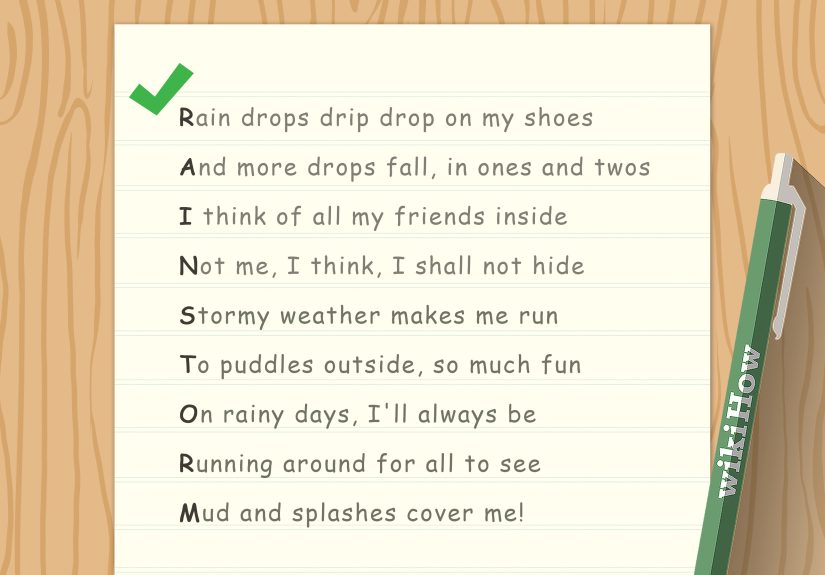
In an acrostic poem, a word (or phrase) is written vertically, and each line begins with the corresponding letter. Those lines connect back to the topic, describe it, or sneak in a hidden message if you’re feeling clever. It’s simple enough for a first-time poet and flexible enough for a seasoned writer who wants a constraint that sparks creativity instead of stress.
What Is an Acrostic Poem?
An acrostic poem is a poem where the first letters of each line spell out a word or phrase when read from top to bottom. Usually, that vertical word is the poem’s topic (like “SUMMER” or “FRIEND”), but it can also be a name, a secret message, or a theme you want to highlight.
Most acrostics use the first letter of each line, but poetry is a playground: you can also experiment with letters at the end of lines (a “telestich”) or down the middle (a “mesostic”). If you’re writing for school, a classroom activity, or a quick creative writing warm-up, the classic “first-letter” style is the easiest and most recognizable.
Why Acrostics Work So Well
Acrostics are popular in classrooms and writing groups for one big reason: they turn “I don’t know what to write” into a step-by-step process. The vertical word gives you a built-in structure, and the lines become small, manageable writing tasks. Instead of staring into the void of a blank page, you’re simply answering: “What can I say about this topic that starts with this letter?”
- Beginner-friendly: No rhyme required (unless you want it).
- Great for vocabulary: You’ll hunt for stronger words and better descriptions.
- Perfect for themes: Names, holidays, seasons, emotions, and “about me” poems work beautifully.
- Quick to draft, easy to revise: Each line can be improved without rewriting the whole poem.
How to Write an Acrostic Poem: 10 Steps
Step 1: Pick a Topic You Actually Care About
Start with something that has opinions. “Pizza,” “basketball,” “my best friend,” “rainy days,” “anxiety,” “spring break,” “my dog who thinks he’s a wolf.” Topics with emotion or sensory detail are easier to write about because you can describe how they look, sound, smell, taste, or feel.
If you’re stuck, choose one of these reliable starters: your name, a hobby, a holiday, a favorite place, a goal you’re working toward, or a feeling you’ve had a lot lately.
Step 2: Choose the “Spine Word” (The Vertical Word or Phrase)
The word you write vertically becomes the poem’s backbone. Short words are easier, long words are more challenging, and phrases are fun if you can handle multiple words (and multiple chances to get stuck on letters like X and Q).
Pro tip: For your first acrostic, aim for 5–8 letters. “SUMMER” (6) is friendlier than “CHARACTER DEVELOPMENT” (18 and emotionally exhausting).
Step 3: Write the Spine Word Vertically
Put each letter on its own line. Capital letters help you see the structure clearly while drafting.
That’s your scaffold. Now you get to build the poem around itone line at a time.
Step 4: Brainstorm Like You’re Collecting Treasure
Before you write full lines, brainstorm words and phrases connected to your topic. Think in categories:
- Senses: What do you see, hear, smell, taste, touch?
- Feelings: What emotions belong with this topic?
- Actions: What does your topic do? What do people do with it?
- Details: Colors, textures, places, memories, tiny specifics.
- Figurative language: Metaphors, similes, comparisons.
Example brainstorm for “SUNSET”: gold, melting sky, quiet streets, warm light, birds, violet clouds, last rays, horizon, day exhaling.
Step 5: Match Brainstorm Words to Tricky Letters First
Some letters are easy (S, T, M). Others act like they didn’t study (X, Q, Z). Save yourself time by tackling the hard letters early. For example:
- Q: quiet, quick, quartz, question, quilt
- X: xylophone, extra, x-ray, xenon (science poets, rise up)
- Z: zippy, zen, zigzag, zesty, zero
If a letter refuses to cooperate, you can adjust the spine word. Poetry is supposed to be fun, not a hostage negotiation.
Step 6: Draft One Line Per Letter (Keep It Simple at First)
Start with straightforward lines that describe your topic. Each line can be a word, a phrase, or a full sentencedepending on the style you want. Many strong acrostics mix short punchy lines with a few longer ones.
Here’s a simple draft for “SUNSET”:
Notice: it doesn’t rhyme, but it still sounds poetic because it uses imagery and rhythm.
Step 7: Add Specific Details That Make It Feel Real
“Nice sunset” is fine. “A sunset that turns the clouds into spilled peach sherbet” is memorable. Great acrostics often get their power from specificity. Upgrade bland lines by adding:
- A concrete object (streetlight, sneakers, a cracked basketball court)
- A sensory detail (warm air, distant traffic, cinnamon smell)
- A tiny moment (a dog pausing mid-walk to stare at the sky)
Try revising one line by replacing a generic word with a sharper one: “beautiful” becomes “amber,” “bright,” “honey-lit,” or “flame-colored.”
Step 8: Choose a Voice (Funny, Serious, Sweet, or Secretly Dramatic)
The same topic can sound totally different depending on tone. Decide what you want your reader to feel:
- Funny: exaggeration, surprise, playful comparisons
- Serious: honest emotion, clean language, strong verbs
- Warm: kindness, gratitude, comforting imagery
- Mysterious: hints, shadows, unanswered questions
A quick trick: write one line as if you’re texting a friend, then rewrite it as if you’re narrating a movie trailer. Pick the version you like best.
Step 9: Revise for Flow, Not Just Letters
Acrostics have two jobs: (1) spell the word, and (2) read like a poem. Revision is where “assignment” turns into “art.”
- Read aloud: If you stumble, the line probably needs tightening.
- Strengthen verbs: “is” and “are” can often become “sparks,” “drifts,” “cracks,” “wraps.”
- Cut filler: Remove extra words that don’t add meaning.
- Look for repetition: Swap repeated words for fresh synonyms.
If you want an extra challenge, try a soft patternlike repeating a sound, a rhythm, or an image (light, heat, color) across multiple lines.
Step 10: Format, Proofread, and Share It Like You Mean It
Before you call it done, check the basics:
- Do the first letters spell the correct word (no accidental typos)?
- Do the lines connect clearly to the topic?
- Are spelling and punctuation clean?
- Does it sound good when read aloud?
Then share itprint it, post it, read it to a friend, add an illustration, or turn it into a classroom display. Acrostics are meant to be seen.
Acrostic Poem Template (Copy-and-Write Friendly)
Want a quick acrostic poem template you can reuse? Pick your word and plug in lines as you draft:
If you’re writing with kids or beginners, you can make it even easier by turning each line into a prompt: “W makes me think of…,” “O reminds me of…,” and so on.
Acrostic Poem Ideas That Practically Write Themselves
If your brain is doing that thing where it’s suddenly “out of thoughts,” try one of these:
- Names: your name, a friend’s name, a pet’s name
- Seasons & holidays: SPRING, SUMMER, HALLOWEEN, NEW YEAR
- Feelings: HOPE, STRESS, JOY, BRAVE
- School themes: SCIENCE, HISTORY, FRIENDS, TEAMWORK
- Life goals: DREAM, FUTURE, FOCUS
- Places: HOME, BEACH, CITY, FOREST
Common Mistakes (And How to Fix Them)
- Mistake: Lines don’t relate to the topic.
Fix: Add a detail that clearly connects (a sense, a memory, an action). - Mistake: The poem feels like a list, not a poem.
Fix: Use imagery, compare things, add motion, or build toward a final line with emotional punch. - Mistake: Awkward words forced to fit letters.
Fix: Rewrite the line so the letter starts a natural phrase, or choose a shorter spine word. - Mistake: Repeating the same adjective (“nice,” “good,” “great”).
Fix: Replace with specifics: colors, textures, sounds, or stronger verbs.
FAQ: Quick Answers About Acrostic Poems
Do acrostic poems have to rhyme?
Nope. Most acrostic poems are written in free verse (no rhyme), especially in school and beginner writing. If you want to add rhyme, keep it lightyour first goal is meaning and flow, not perfect end sounds.
How long should each line be?
There’s no required length. Some acrostics use one word per line; others use full sentences. A good rule: keep lines consistent enough to feel intentional, but varied enough to stay interesting.
Can an acrostic spell a secret message?
Absolutely. That’s part of the fun. You can spell a name, a dedication, a theme, or a hidden note. Just make sure the poem still makes sense on its ownotherwise it becomes a code with extra steps.
Is an acrostic poem “real poetry”?
Yes. Poetry isn’t defined by difficulty. It’s defined by intention, language, sound, and meaning. Acrostics simply add a structural constraintlike a puzzle piece that helps you build something creative.
Conclusion
Writing an acrostic poem is one of the simplest ways to turn an idea into a finished piece of writingfast. Choose a topic, write your spine word vertically, brainstorm details, and draft one line per letter. Then revise for stronger imagery and smoother flow, proofread the acrostic letters, and share it proudly. The best part? Every acrostic you write trains your writing muscles: word choice, detail, voice, and revision. That’s not just poetry; that’s leveling up.
Experiences That Make Acrostic Poems Stick (And Actually Feel Fun)
If you’ve only seen acrostics as a neat little school worksheet, you’re missing their secret superpower: they’re sneaky confidence-builders. In many classrooms and writing circles, the first time someone claims they “can’t write poetry,” an acrostic is the friendly on-ramp that proves otherwise. There’s something reassuring about having a structure that says, “Don’t panicjust start with this letter.”
One common experience is the name acrostic: people write their name down the page and suddenly realize they have more to say about themselves than they expected. It often starts as simple traits“Kind,” “Funny,” “Quiet”but as they revise, the poem gets more specific: “Keeps earbuds in to survive loud hallways,” “Finds comfort in midnight snacks,” “Quiet until the topic is something I love.” The moment it clicks is when the writer stops listing labels and starts writing images. That shiftfrom “I am nice” to “I leave the last slice for someone else”is where the poem becomes personal.
Another familiar scene: a group writing acrostics around a shared theme like TEAMWORK or COMMUNITY. At first, everyone reaches for the same safe words (helpful, kind, together). But the best lines show up when someone adds a concrete detail: “TTexting the group chat ‘I’ve got you’ before the presentation,” or “WWiping the whiteboard while someone else talks.” Specific moments feel true, and “true” is a magical ingredient in poetry.
If you’re writing solo, an acrostic can feel like a creative warm-up that accidentally becomes a finished draft. Writers often start one as a quick exercisesay, “SPRING”and then notice a surprising emotion hiding in the lines. Maybe the poem becomes less about flowers and more about relief, restlessness, or starting over. That’s a real pattern: the structure gets you moving, and movement reveals meaning. It’s like walking into a room to grab something and discovering you also needed a snack and an existential reset.
The “stuck letter” experience is also universal. You’ll fly through S and T and then hit a letter like U and suddenly your brain becomes a blank desktop screen with one lonely cursor blinking. The trick most writers learn is to change the question. Instead of “What line starts with U?” ask “What does my topic do that starts with U?” (Unfolds, Upshifts, Unravels, Unites). Or change the form: let the line start with “Under…” or “Until…” to give yourself a runway. Once you’ve solved a few tricky letters this way, you start to trust that you can solve the next one tooand that confidence carries into other kinds of writing.
Finally, acrostics tend to shine when they’re shared. Posted on a bulletin board, read at the end of class, tucked into a birthday card, or turned into an illustrated pageacrostic poems are naturally “displayable.” They look like poetry, even before you read them. And when readers notice the vertical word and grinbecause they got the hidden structurethat little moment of connection is a real writing win. It reminds you that poems aren’t just private thoughts. They’re messages that land.
So if you want an experience-based takeaway, it’s this: acrostics are not “baby poetry.” They’re training wheels that can still do tricks. Use them to start, to practice, to play, to teach, or to say something you meanone letter at a time.