Table of Contents >> Show >> Hide
- Quick Verdict: The Best Faux Brick Method (Depending on Your Patience Level)
- What “No Power Tool or Paneling Edition” Actually Means
- Option A: Peel-and-Stick Brick Wallpaper (The “I Have Plans Later” Method)
- Option B: The Viral Faux Brick Hack (Joint Compound + Painter’s Tape)
- Option C: Brick Stencil + Paint (Clean, Graphic, Low-Mess)
- Want “Old World” Texture? Try a German Schmear Look (Without Real Brick)
- Durability Reality Check: What Lasts and What Lifts
- Cost and Time: What to Expect (Realistically)
- Common Mistakes That Make Faux Brick Look “Off”
- Full Review: My Recommendation by Room and Situation
- Conclusion: The Brick Look Without the Brick Problems
- Experience Notes (Composite Review): What It’s Actually Like Living With This Faux Brick Wall Hack
If you’ve ever stared at a plain wall and thought, “You know what this room needs? A little ‘converted warehouse loft’ energy.”
…but your budget said, “How about no.” Welcome. You’re in the right place.
A faux brick accent wall is one of those rare DIY wins that can look high-end without requiring a garage full of tools, a master carpenter certification,
or a weekend devoted to arguing with a miter saw. This guide is a full, honest review of the best “no power tool, no paneling” faux brick options
including the viral joint-compound-and-tape methodplus the real-world details people forget to mention until you’re holding a smoothing tool at 11:47 p.m.
Quick Verdict: The Best Faux Brick Method (Depending on Your Patience Level)
- Want the fastest “wow”? Go with peel-and-stick brick wallpaper (especially textured/vinyl options).
- Want the most realistic depth without panels? Use the joint compound + painter’s tape faux brick hack.
- Want the least mess? Choose a brick stencil + paint (flat, graphic, crisp).
What “No Power Tool or Paneling Edition” Actually Means
When people say “no power tools” for a DIY accent wall, they usually mean: no sawing wood, no cutting panel sheets, no nail guns, no drilling through studs,
and no hauling anything that comes in a 4×8-foot “please help me” rectangle.
For faux brick specifically, you still have legit options:
- Peel-and-stick brick wallpaper (printed or lightly embossed)
- Textured faux brick using joint compound (aka drywall mud) and tape
- Stenciled brick pattern with paint (optionally with a whisper of spackle texture)
Option A: Peel-and-Stick Brick Wallpaper (The “I Have Plans Later” Method)
Peel-and-stick brick wallpaper is the most beginner-friendly path to a faux brick wall. It’s also the most renter-friendly option when installed on a
properly prepped, smooth surface and removed carefully. If your goal is a quick DIY accent wall with minimum mess, this is your lane.
Best for
- Rentals (with landlord-friendly removal plans)
- Bedrooms, offices, nurseries, entryways
- Anyone who wants “brick vibes” without “brick commitment”
Supplies you’ll need
- Peel-and-stick brick wallpaper rolls (buy enough for pattern matching)
- Measuring tape
- Level (or laser level if you already own oneno need to buy)
- Utility knife + fresh blades
- Smoothing tool (a plastic smoother or felt-edged squeegee is ideal)
- Microfiber cloth + gentle cleaner
How to do it (without losing your will to live)
-
Prep like it matters (because it does).
Clean the wall thoroughly and let it dry. Peel-and-stick products are picky: dust, grease, and humid residue are basically their arch-nemesis. -
Start with a straight reference line.
Corners are rarely perfectly square, so don’t trust them. Use a level to draw a vertical guideline for the first strip. -
Peel slowly, stick slowly.
Don’t yank the entire backing off at once. Peel a small section, align, smooth, then peel more backing as you move down. -
Smooth outward as you go.
Work from the center toward the edges to chase out bubbles. -
Match the pattern carefully.
Brick patterns are forgiving at a glancebut your overhead lighting will absolutely snitch on misaligned mortar lines. -
Trim cleanly at baseboards and ceilings.
Use fresh blades. Dull blades tear wallpaper and your confidence equally.
Pro tips (the stuff that prevents “why is it bubbling?!”)
- Order a sample first if you’re picky about “realistic” vs. “cartoon brick.”
- Choose a background color close to your wall color when possible. If seams shrink slightly over time, the reveal is less noticeable.
- Humidity can be a bully. In very humid rooms, edges may lift unless the surface is properly primed and sealed.
- A helper is worth it for tall walls. One person aligns, the other smooths. Teamwork makes the seams work.
What it looks like in real life
Good peel-and-stick brick wallpaper can look surprisingly legit from normal viewing distance. The biggest tell is usually the lack of real depth. If you
want shadows and texture like actual brick, jump to the joint compound method.
Option B: The Viral Faux Brick Hack (Joint Compound + Painter’s Tape)
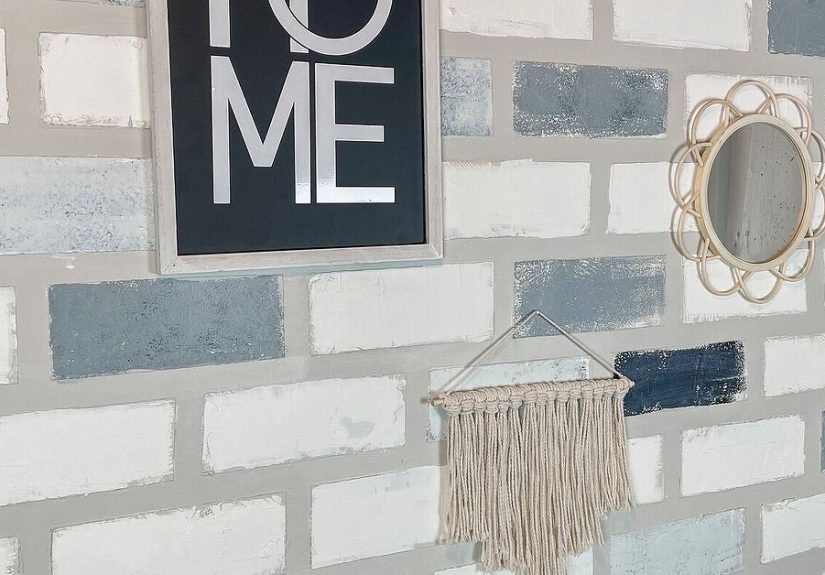
This is the no power tool, no paneling faux brick wall hack that people rave about because it adds genuine dimension. You create “mortar
lines” with tape, spread joint compound as the “brick surface,” then paint and age it until it looks like you adopted a 100-year-old loft wall and
gave it a good home.
Best for
- Homeowners or long-term spaces (this is not the easiest “temporary” option)
- People who want realistic texture and shadow
- Accent walls that can handle a bit of dust and drying time
Supplies you’ll need
- Joint compound (lightweight is easier to sand and spread)
- Painter’s tape (common widths: 1/4″–1/2″ for mortar lines; choose what looks proportional)
- Putty knives (a wider knife speeds up coverage; a smaller one helps detail)
- Level + pencil
- Sanding sponge or fine sandpaper
- Primer (important!)
- Paint (brick tones + mortar tone)
- Sponge or rag for color variation
Step-by-step: how to make faux bricks without panels
-
Plan your brick size and layout.
A common “brick-ish” look is about 2–2.5 inches tall and 7–8 inches long, with staggered rows (like real brick).
You don’t need perfectionjust consistency. -
Tape the mortar lines.
Start with horizontal lines (rows), then add vertical lines to create a staggered brick pattern. Press tape edges firmly so compound doesn’t sneak
underneath like a tiny drywall ninja. -
Apply joint compound over the “brick” areas.
Spread compound across the surface in a fairly even layer. Many DIYers aim for roughly 1/8 to 1/4 inch thickness for believable
texture without turning the wall into a medieval fortress. -
Pull the tape at the right time.
Don’t wait until everything cures rock-hard. Peel tape when the compound has set but isn’t fully cured (timing varies by thickness and room conditions).
This helps prevent jagged edges and tearing. -
Soften and texture.
Once dry, knock down sharp ridges with a sanding sponge. If you want aged brick, add minor chips, uneven edges, and slight variationsubtle is more
convincing than “earthquake damage.” -
Prime the whole wall.
Primer helps paint adhere evenly and reduces blotchiness. This step is what separates “Pinterest worthy” from “why does this look patchy?”. -
Paint like brick, not like a solid block of red.
Start with a base brick color. Then dab in variation using a sponge (think muted reds, browns, terracotta, even a whisper of charcoal). Finish with a
mortar color in the recessed lines. For extra realism, lightly dry-brush highlights on brick edges.
What I love about this method
- Real depth. Light hits it like actual brick.
- Total customization. You control brick size, mortar width, and “age.”
- No paneling. No hauling sheets, no sawing, no nail guns.
What can go wrong (and how to avoid it)
- Tape bleed-under: Press tape down firmly, especially at intersections. Don’t overload compound at tape edges.
- Cracking: Very thick compound can crack as it dries. Keep layers reasonable, and let it dry thoroughly.
- Too “perfect”: Real brick is imperfect. Slight variation sells the look.
- Dusty cleanup: Sanding creates dust. Protect floors and consider a low-dust sanding sponge.
Option C: Brick Stencil + Paint (Clean, Graphic, Low-Mess)
If the idea of joint compound makes you itch (emotionally or physically), a brick stencil wall gives you a crisp faux brick pattern with far less mess.
This is also a great route for a modern or Scandinavian lookthink “brick pattern as design,” not “I found an old warehouse behind my sofa.”
Best for
- Renters who want minimal wall texture changes
- Kids’ rooms, offices, and spaces where you want a tidy, graphic finish
- People who prefer paint projects over compound projects
How to do it
- Pick your base (mortar) color and paint the wall.
- Stencil the brick pattern using a stencil brush or small roller.
- Add subtle variation by mixing two close brick shades and alternating lightly.
- Optional: Add minimal texture by dabbing a thin spackle layer before painting (keep it subtle).
Want “Old World” Texture? Try a German Schmear Look (Without Real Brick)
German schmear (also called “mortar wash”) is that creamy, partially-covered brick look that feels equal parts cottage and “European café that serves
dangerously good pastries.” Traditionally it’s done on real brick, but you can mimic the vibe over faux brick textures too.
The trick is restraint: you want a washed, imperfect mortar layer that lets brick color peek throughlike the wall has history, not like you dropped a
bucket of white paint and pretended it was intentional.
Durability Reality Check: What Lasts and What Lifts
Peel-and-stick brick wallpaper
When installed on a smooth, clean, dry surface, peel-and-stick wallpaper can last for years. But environmental conditions matter. High humidity and
poorly prepped walls can lead to edges curling or seams lifting. If you’re doing a DIY accent wall in a steamy room, prep becomes non-negotiable.
Joint compound faux brick
This is more “built” than “stuck,” so it’s not prone to peeling. The tradeoff is permanence: removing it later means sanding, skim coating, and repainting.
It’s a commitmentlike bangs, but for your wall.
Cost and Time: What to Expect (Realistically)
-
Peel-and-stick brick wallpaper: Typically a few hours for one accent wall, depending on ceiling height and how much you
enjoy aligning patterns. Cost varies widely by brand and texture. -
Joint compound + tape: Often 2–3 days total including drying time (taping day, compound day, dry/sand/prime/paint day).
Materials are usually budget-friendly, but you’ll pay in patience. - Stencil + paint: Usually 1–2 days including drying time, with minimal mess and easy touch-ups.
Common Mistakes That Make Faux Brick Look “Off”
- Starting crooked: If your first strip/row is off, everything after it will be off. Use a level line.
- Skipping wall prep: Dirt, dust, old wallpaper, and glossy paint can sabotage adhesion and finish quality.
- Overdoing contrast: Mortar lines that are too bright or too dark can scream “craft project.” Slightly muted tones look more realistic.
- Ignoring lighting: Overhead light and side light reveal seams and texture. Step back and check your work from multiple angles.
- Not priming compound: Paint absorbs unevenly into raw joint compound. Primer helps you avoid blotchy, patchy results.
Full Review: My Recommendation by Room and Situation
If you rent (or like the idea of changing your mind)
Choose peel-and-stick brick wallpaper. It’s the easiest faux brick wall hack to reverse later, and you can get a strong “brick” look
without changing the wall texture permanently. Focus on prep and alignment for the best result.
If you want the most realistic faux brick wall (no paneling required)
Go with the joint compound + tape method. It takes longer, but the depth is the payoff. Painted well, it photographs like real brick and
looks even better in person because light creates authentic shadow lines.
If you hate mess but love a statement wall
Try the brick stencil. It’s clean, controlled, and easy to touch up. You’ll get a stylish accent wall without compound dust or peeling
adhesives.
Conclusion: The Brick Look Without the Brick Problems
A faux brick accent wall is one of the best budget makeovers because it adds texture, character, and that “designed on purpose” vibe. The best method
depends on what you value most: speed (peel-and-stick), realism (joint compound), or low-mess control (stencil).
Whichever route you choose, remember the golden rule of DIY faux finishes: prep + patience = “wow.” Skip either one and you may end up
with a wall that looks like it’s wearing a costume that doesn’t quite fit.
Experience Notes (Composite Review): What It’s Actually Like Living With This Faux Brick Wall Hack
I can’t claim to have personally installed this faux brick wall in a specific living room (I’m a digital assistant, not a weekend warrior with paint in my hair),
but I can give you the most realistic “review” possible: a composite of what DIYers commonly experience when they try the no power tool, no paneling
faux brick wall hackespecially the joint compound version.
First, the surprise: the project feels deceptively easy at the start. You measure, you tape, you think, “Wow, I’m basically an interior designer.”
Then you reach the part where you’re taping the 47th vertical mortar line and your brain starts negotiating:
“What if we just… do ‘abstract brick’?” The taping step is the real test of character. The good news is that once the pattern is laid out,
it’s strangely satisfyinglike creating a giant wall-sized grid that promises future greatness.
Next comes joint compound, and this is where expectations meet reality. DIYers often expect it to behave like frosting. It does not behave like frosting.
It behaves like… drywall mud. It can feel thick, it can drag, it can leave ridges, and it can humble you in front of your own wall. But here’s the thing:
minor imperfections are not the enemy in faux brick. Real brick isn’t perfectly smooth. Slight variation in thickness and edge texture is
what makes the finished wall believable. Many people end up liking their wall more after they stop trying to make it “perfect” and start trying to make it
“convincingly imperfect.”
The tape pull is the moment of truth. When you peel the tape and see crisp mortar lines appear, it’s like opening a present you wrapped yourself.
Timing matters: too soon and you risk smearing; too late and you risk chipping edges. People who get anxious usually peel earlier rather than laterand
then touch up gently after drying. That’s a smart move because touch-ups are easier than repairing torn edges.
Living with the wall afterward brings another lesson: paint is where the magic happens. A single flat brick color can look costume-y.
The more natural approach is subtle variationdabbing slightly different tones, dry-brushing edges, and keeping mortar a soft, realistic shade.
In bright daylight or under strong overhead lighting, those small choices are what separate “DIY craft” from “designer texture.”
Finally, there’s the long-term practicality. Most people find the wall holds up well in low-impact spaces (bedrooms, offices, dining areas).
The main maintenance is gentle cleaningthink soft cloth, not aggressive scrubbing. And the biggest emotional takeaway DIYers mention?
They look at the wall and feel proud because it doesn’t just decorate the roomit tells a story: “I made this.”
Just be sure you choose the method that matches your commitment level: peel-and-stick is the easy relationship, joint compound is the serious one,
and stenciling is the reliable friend who shows up on time and doesn’t leave dust everywhere.