Table of Contents >> Show >> Hide
- What Does “Shifting” Mean in a Ratchet Wrench?
- Anatomy of a Ratcheting Wrench Mechanism
- Key Design Decisions (Where Great Ratchets Are Born)
- Materials and Manufacturing: The Truth About “Building” One
- Build Plan: A Practical, No-Fantasy Workflow
- Step 1: Define specs (don’t skip this)
- Step 2: Pick your ratchet architecture
- Step 3A (Prototype path): Source a proven mechanism
- Step 3B (Engineering path): Design the gear + pawl interface
- Step 4: Build the “shifting” features
- Step 5: Machine/shape the head and handle
- Step 6: Heat treat and surface protection (if applicable)
- Step 7: Assembly, lubrication, and sealing
- Testing: Prove It Works Before It Betrays You
- Common Failure Modes (and How to Design Around Them)
- Maintenance Tips for a Shifting Ratcheting Wrench
- Quick FAQ
- Conclusion: Build Smart, Shift Smarter
- Shop Notes: of Real-World Experience (So You Don’t Learn the Hard Way)
A ratchet wrench is basically a productivity cheat code: you move your hand back and forth, the fastener keeps
turning in the “good” direction, and you get to feel like you’ve discovered time travel. A shifting ratchet wrench
takes that idea one step furtherby letting you “shift” how the tool behaves in tight spaces: changing direction on the fly, changing head angle,
and (if you design it right) changing engagement style so the wrench keeps working when clearance is measured in single-digit millimeters and pure hope.
In this guide, we’ll break down how a shifting ratcheting wrench works, what separates a “toy ratchet” from a professional-grade mechanism,
and how you can build oneeither as a serious engineering project or as a practical prototype using real hardware.
Expect mechanical details, design trade-offs, and a few jokesbecause if you can’t laugh while fighting a rounded bolt, what are we doing here?
What Does “Shifting” Mean in a Ratchet Wrench?
“Shifting” isn’t one universal spec stamped into the handle. In practice, people use it to describe three related capabilities:
- Directional shifting: switching from tighten to loosen without flipping the wrench 180° (a reversing lever, switch, or knob).
- Positional shifting: changing head angle (flex-head) or offset to snake around obstructions.
- Engagement shifting: improving how the pawls bite into the gearfine-tooth, dual-pawl, or multi-stage designs that “catch” sooner.
When you’re building a shifting ratchet wrench, you’re really designing a compact mechanical system that:
(1) transmits torque reliably, (2) survives repeated load cycles, and (3) keeps doing its job after living in a world of grit, grease, and regret.
Anatomy of a Ratcheting Wrench Mechanism
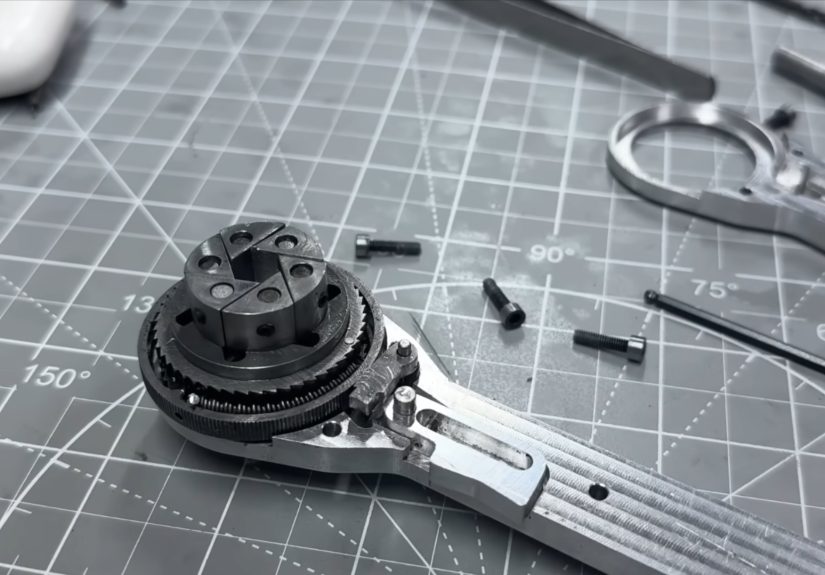
Most ratcheting wrencheswhether a ratcheting box end or a socket ratchetboil down to the same cast of characters:
1) Ratchet gear (ring gear)
A toothed gear is the “clicky” heart of the tool. Tooth count matters because it determines the working swing arc:
the minimum angle you need to move the handle before the mechanism grabs the next tooth.
Rough math: Working arc ≈ 360° ÷ tooth count.
So a 72-tooth mechanism lands around 5°, 90-tooth around 4°, and 120-position designs around 3°.
2) Pawl(s)
A pawl is a spring-loaded lever that engages the gear teeth in one direction and glides over them in the other.
More pawls (or clever pawl geometry) can mean stronger engagement, smoother feel, and shorter arcbut also more complexity and tighter tolerances.
3) Springs, pins, and a selector
Springs keep pawls pressed into the gear. A reversing lever (or dial) shifts which pawl face engages, changing direction.
In a “sealed” or enclosed head, you also design for lubrication retention and contamination resistancehuge for real-world durability.
4) The head and the handle
The head houses the mechanism. The handle delivers leverage. That sounds obvious until you realize your handle is also a structural beam
dealing with bending stress, torsion, and the occasional “I can totally break this loose” overconfidence moment.
Key Design Decisions (Where Great Ratchets Are Born)
Tooth count vs. strength
Fine-tooth mechanisms shine in tight spaces because they need less movement to re-engage.
But smaller teeth can concentrate stress. Strong designs compensate with better materials, better heat treat,
more pawl contact area, or multi-pawl engagement that spreads load across multiple teeth.
6-point vs. 12-point box end
If you’re building a ratcheting box end, decide whether the ring is 6-point or 12-point.
6-point typically offers more contact area on the flats (helpful for resisting rounding),
while 12-point offers easier indexing in tight spaces. Many premium designs optimize the geometry to grip flats rather than corners.
Offset angle and flip trick
A common ergonomic move is a ~15° offset on the box end and/or open end so your knuckles don’t become the sacrificial anode.
Many combination wrenches also angle the open end so you can flip the wrench to effectively double engagement opportunities in confined areas.
Flex-head “shifting”
A flex-head lets the head pivot, often up to ~180°. Add a locking mechanism with multiple positions, and you get a controlled “shift”
in access angle without the head flopping like a fish. This is where compact, strong pivot design becomes its own mini engineering project.
Materials and Manufacturing: The Truth About “Building” One
Let’s be honest: a professional ratcheting wrench is usually forged from alloy steel, precision-machined,
heat-treated, and finished for corrosion resistance. That’s industrial territory.
But “building” can mean two valid paths:
- Engineering build (from raw steel): design + machine + heat treat + assemble. Difficult, but incredibly educational.
-
Prototype build (from proven components): use an existing ratchet mechanism (or service kit) and build your own head/handle around it.
Faster, safer, and more likely to produce a usable tool.
Material choices
Tool makers often use alloys like chrome-vanadium steel for strength and toughness, then tune hardness via heat treatment.
Your goal: a head that resists wear at the teeth/pawl interface, and a handle that won’t permanently deform under torque.
Heat treatment (why it matters)
Teeth and pawls live a rough life: repeated contact stress, sliding friction, and impact-like loading when the pawl snaps into a tooth.
Too soft and it wears fast. Too hard and it can chip. The “sweet spot” is controlled hardness with toughnessachieved through proper heat treat
(and verified by testing, not vibes).
Finishing
Chrome or other corrosion-resistant finishes make cleanup easier and slow rust. If you’re prototyping,
even a basic protective finish and sensible lubrication strategy can dramatically extend life.
Build Plan: A Practical, No-Fantasy Workflow
Below is a realistic build sequence that respects physics, budget, and the fact that most of us don’t have a forging press next to the toaster.
Choose the branch that fits your shop.
Step 1: Define specs (don’t skip this)
- Size: combination wrench size (e.g., 10 mm, 1/2″) or a drive size (1/4″, 3/8″, 1/2″).
- Arc target: 5° (72-tooth), 4° (90-tooth), 3° (120 positions), etc.
- Shift features: reversible lever? flex-head with lock? offset head?
- Use case torque: light assembly vs. heavy automotive work.
Step 2: Pick your ratchet architecture
Here are common architectures you can build around:
- Single pawl + fine-tooth gear: simpler, compact, good for prototypes.
- Dual pawl / multi-tooth contact: can improve strength and smoothness by sharing load.
- Double-stacked pawl concepts: higher “positions” with smaller arc, but demands precision.
- Multi-stage engagement (specialty): staggered pawl action that can create more engagement points per tooth.
Step 3A (Prototype path): Source a proven mechanism
The fastest route to a functional shifting ratchet wrench is to start with a known-good mechanism:
a ratchet head assembly, replacement kit, or a donor wrench/ratchet that you can integrate.
You’ll still do real design workpackaging, selector ergonomics, head sealing, pivot lockingbut you avoid reinventing hardened gear teeth.
Step 3B (Engineering path): Design the gear + pawl interface
If you’re machining your own:
- Tooth geometry: tooth profile must allow easy overrun in one direction and positive lock in the other.
- Pawl face angle: aim for secure engagement under load, not a “barely holding on” situation.
- Contact area: more area reduces stress; tight corners concentrate stress.
- Lubrication pockets: keep grease where it belongsinside the head, not on your jeans.
Step 4: Build the “shifting” features
This is where your wrench becomes more than a clicker.
Directional shifting (reversing lever)
Design a lever that changes pawl engagement cleanly and can’t half-engage under load.
Keep it low-profile so it won’t snag in tight spaces, but large enough to operate with gloves.
Positional shifting (flex-head + lock)
A pivoting head needs:
- Pivot pin/bolt sized for shear and fatigue.
- Locking detents (multiple positions) or a robust friction lock.
- Controlled clearance so it pivots smoothly but doesn’t wobble.
Step 5: Machine/shape the head and handle
Even with a donor mechanism, you’ll likely fabricate a head pocket, cover plate, selector slot, and handle geometry.
Prioritize:
- Strength around the head (thin walls crack; thick walls don’t fit).
- Comfort (rounded edges; finger clearance; no “cheese grater” knurling).
- Access (low profile head; smart offsets).
Step 6: Heat treat and surface protection (if applicable)
If you created critical steel parts (gear, pawl, head), heat treatment is not optional if you expect longevity.
If you’re prototyping, you can still improve durability with better materials, hardened inserts, or using hardened donor parts for the wear interfaces.
Step 7: Assembly, lubrication, and sealing
Assemble with intentional lubricationtoo little and it feels gritty; too much and it becomes a dirt magnet.
If you can, use a cover design that reduces contamination entry. A cleaner mechanism keeps engagement crisp and wear slower.
Testing: Prove It Works Before It Betrays You
A ratchet wrench doesn’t fail politely. It fails at the exact moment your knuckles are aligned with sharp metal.
Test like you care about your hands.
Functional tests
- Backdrag: does it resist movement when it should be free? Too much backdrag feels awful in tight spaces.
- Engagement consistency: does it “catch” reliably across the full arc?
- Selector reliability: does the reversing lever fully lock in both directions?
- Flex lock security: can the head hold angle under realistic torque?
Load tests (responsibly)
Apply increasing torque gradually, using fixtures and safety precautions.
Watch for pawl skipping, tooth deformation, pivot slop, and handle bending. If anything “clicks” in a new and exciting way, stop and inspect.
Wear tests
Run repeated cycles. Ratchets often feel great for 20 minutesthen wear shows up.
Look for polishing, chipping, burr formation, and spring fatigue. In the long run, the little parts (springs, pins) deserve big respect.
Common Failure Modes (and How to Design Around Them)
Pawl slip / tooth skip
Usually caused by poor tooth geometry, insufficient pawl engagement depth, weak springs, or surface hardness issues.
Fix by increasing engagement, improving geometry, upgrading spring force (carefully), and ensuring proper hardness/toughness balance.
Rounded fasteners (the “why did I even try?” moment)
Often a fit problem: wrong size, worn profile, or geometry that contacts corners.
Favor designs that grip flats, keep tolerances tight, and choose 6-point where higher torque and reduced rounding risk matter most.
Flex-head wobble
Pivot wear grows into wobble, wobble becomes misalignment, and misalignment becomes broken engagement.
Design for load paths, use hardened pivot components where possible, and keep clearances controlled.
Contamination + dried grease
Dirt in the head turns smooth pawl action into crunchy sadness.
Better sealing, sensible grease, and easy service access help.
Maintenance Tips for a Shifting Ratcheting Wrench
- Keep it clean: wipe after use, especially around the selector and pivot.
- Grease with restraint: enough for lubrication, not enough to attract an entire sandbox.
- Inspect the “shift” parts: reversing lever crisp? flex lock holding? pivot slop growing?
- Use the right tool for the job: ratcheting wrenches are for speed; break stubborn fasteners loose with a breaker bar or standard wrench first.
Quick FAQ
Is a higher tooth count always better?
Not always. Higher tooth counts reduce swing arc (awesome in tight spots), but can demand better design and materials to keep strength and durability high.
The “best” depends on clearance, torque demands, and mechanism quality.
What’s the most realistic way to build one at home?
Prototype around a proven ratchet mechanism, then design your own head/handle geometry and shifting features.
You’ll learn the important packaging and ergonomics challenges without needing to perfect gear heat treat from scratch.
How do I make the shift feel “premium”?
Crisp detents, low backdrag, solid engagement, and a selector that never half-engages.
Premium feel is mostly precision + lubrication + smart tolerancesnot magic.
Conclusion: Build Smart, Shift Smarter
Building a shifting ratchet wrench is part mechanical design, part materials science, and part “how do I fit all of this into a head the size of a cookie?”
Whether you’re engineering one from raw stock or prototyping around a proven ratchet core, the winning formula stays the same:
strong engagement, short working arc, reliable direction shifting, and access-friendly head geometry.
The best ratcheting wrenches don’t just clickthey inspire confidence. And if your prototype doesn’t inspire confidence yet, that’s not failure.
That’s the sound of your design learning to behave.
: experiences section
Shop Notes: of Real-World Experience (So You Don’t Learn the Hard Way)
Ask a few mechanics what they want from a ratcheting wrench and you’ll get the same theme in different accents:
“I want it to fit, I want it to bite, and I want it to stop slipping right when my hand is about to introduce itself to the chassis.”
That’s why the “shifting” featuresdirection switch, flex-head, compact arcmatter so much in the real world.
One of the most common lessons from tool users is that ratchets are not breakup tools. People love the speed of a ratcheting box end,
so they try to crack loose a corroded fastener with it. Sometimes it works. Sometimes the pawl skips, the teeth take a little bite out of each other,
and the wrench develops a brand-new “feature” called unpredictable engagement. In practice, pros often break the fastener loose with a non-ratcheting wrench
or breaker bar, then switch to the ratcheting wrench to spin it out quickly. If you’re designing your own wrench, assume users will ignore this advice and
build your engagement geometry accordingly.
Another repeated theme: backdrag makes or breaks a tight-space tool. A mechanism can have a gorgeous 3° arc on paper, but if the backdrag is high,
you’ll still be fighting it in cramped bays. Designers and tool tinkerers learn to obsess over lubrication, surface finish, spring force, and sealing.
Too much spring pressure can make engagement “secure,” but it can also make the free stroke feel sticky. Too little pressure feels buttery… right up until it skips.
The sweet spot is the one that stays consistent after it’s dirty, warm, and used at awkward angles.
Flex-head locks are another source of “experience.” Users tend to love a locking flex head until it starts drifting under load.
That drift usually traces back to pivot wear, soft pivot components, or a detent system that’s strong in one direction and weak in another.
A practical takeaway is to design the pivot like it’s a structural joint, not a convenience hinge: load paths, hard bearing surfaces,
controlled clearances, and a lock that doesn’t depend on hope as a retaining strategy.
Finally, the best “shop wisdom” is boring but true: fit is performance. A ratcheting box end that grips flats, stays square,
and doesn’t wobble will outperform a fancier mechanism with sloppy tolerances. If you build a prototype, spend time on the unglamorous stuff:
ring geometry, head stiffness, selector crispness, and finishing the edges so it feels like a tool you trustnot a metal rumor.