Table of Contents >> Show >> Hide
- 1) Start With a Simple “Bedroom Brief” (Yes, Like a Tiny Design Memo)
- 2) Choose a Color Strategy That Doesn’t Fight Your Sleep
- 3) Layer Your Lighting (Because One Overhead Light Is a Villain)
- 4) Make the Bed the Star (Not the Pile of “Clothes That Are Clean-ish”)
- 5) Rugs, Curtains, and Wall Treatments: The Quiet Power Trio
- 6) Bedroom Storage Ideas That Don’t Look Like Storage
- 7) Small Bedroom Decorating Ideas (When the Bed Is Basically the Room)
- 8) Pick a Style Direction (So Your Room Stops Arguing With Itself)
- 9) Budget-Friendly Bedroom Upgrades That Look Legit
- 10) The “Don’t Ruin It” Checklist (Common Bedroom Design Mistakes)
- Wrap-Up: A Bedroom That Feels Good (Not Just Looks Good)
- Real-World “Experience” Notes: What Actually Happens When You Redecorate a Bedroom (And How to Win Anyway)
Your bedroom has one job: help you recharge. But somehow it also becomes a storage unit, a doom-scrolling theater,
a “clean laundry museum,” andif you’re luckya place where you actually sleep. The good news? You don’t need a
full renovation or a celebrity designer hiding in your closet to make your space feel calmer, prettier, and
more you. With a few smart design moves, you can create a bedroom that looks pulled together in daylight
and feels like a warm exhale at night.
Below are practical, real-world bedroom decorating and design ideascolor, lighting, layout, storage, style,
and budget upgradeswritten for actual humans with actual bedrooms (including small ones where the bed eats
73% of the floor plan like it pays rent).
1) Start With a Simple “Bedroom Brief” (Yes, Like a Tiny Design Memo)
Before you buy another throw pillow with big opinions, take five minutes and answer two questions:
- How do I want this room to feel? (cozy, airy, romantic, hotel-like, minimal, colorful, etc.)
- What does it need to do? (sleep only, sleep + WFH corner, nursery share, lots of storage, etc.)
That’s your filter. When a purchase doesn’t match the vibe or the function, it’s a “no,” no matter how cute it
looked in someone else’s reel.
Quick layout reality check
The bed is the visual anchor, so place it where it feels intentional: typically centered on the main wall
(the wall you see first) if possible. If the room is tight, don’t panicsymmetry is optional; comfort is not.
Aim for a clear walkway on at least one side of the bed, and keep door swings and drawers from playing bumper cars.
2) Choose a Color Strategy That Doesn’t Fight Your Sleep
Bedroom color schemes matter because color is basically mood with a paint swatch. A safe, timeless approach is
to pick one dominant color, one supporting color, and one accent. A popular designer guideline is the
60-30-10 rule: 60% dominant (often walls), 30% secondary (bedding/furniture), 10% accent
(art, pillows, décor). It keeps things cohesive without making your room look like a matching set from a catalog.
Color ideas that work in real bedrooms
- Soft neutrals + texture: Warm off-whites, creamy beige, greigethen add interest with linen, wood, boucle, and woven pieces.
- Moody “cocoon” tones: Deep navy, charcoal, forest green, or aubergine for a cozy, hotel-bar-lounge vibe (in a good way).
- Calm color washes: Sage, dusty blue, muted clayespecially nice if your bedroom doubles as a stress-management station.
- Monochrome done right: One color family, multiple shades (walls, rug, bedding) so it feels layered, not flat.
If repainting isn’t happening right now, steal the same effect with textiles: duvet cover, curtains, rug, and a
few accents in a controlled palette. Your walls can stay as-is while your bed does the heavy lifting.
3) Layer Your Lighting (Because One Overhead Light Is a Villain)
If your bedroom lighting is a single ceiling fixture that screams “interrogation room,” you’re not alone.
Designers recommend layered lightingmixing ambient, task, and accent lightso the room works for
reading, getting dressed, and winding down.
Build a simple lighting “stack”
- Ambient: A ceiling fixture, flush mount, or pendant for overall light.
- Task: Bedside lamps or wall sconces for reading (bonus points if you can reach the switch without doing yoga).
- Accent: A small table lamp across the room, picture light, LED strip behind a headboard, or soft plug-in sconce.
Add dimmers when possible, and pick warm bulbs for nighttime calm. A softer, warm glow (often in the 2700K–3000K
range) helps the room feel relaxing instead of like a dentist’s waiting area.
Small bedroom lighting trick
When floor space is limited, go vertical: wall sconces, swing-arm lamps, or plug-in pendants free up nightstand
space and make the room feel less clutteredlike your surfaces can finally breathe.
4) Make the Bed the Star (Not the Pile of “Clothes That Are Clean-ish”)
The easiest way to upgrade a bedroom is to upgrade what you see most: the bed. Think of it as your room’s
“home screen.”
Headboard, please
A headboard instantly makes a room feel finished. Upholstered headboards add softness and sound absorption;
wooden or metal options add structure; a DIY approach (painted arch, wall panels, or a tall upholstered board)
can deliver drama on a realistic budget.
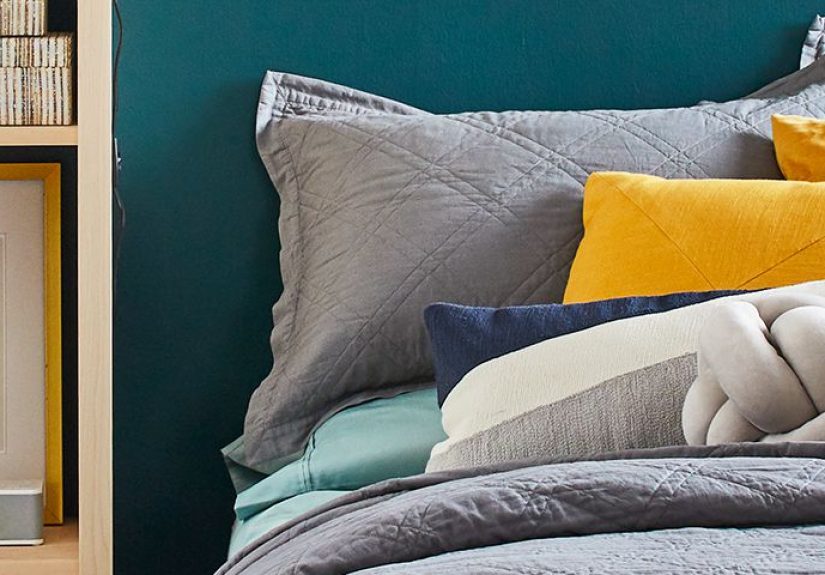
Bedding that looks styled, not staged
- Start with good sheets (whatever “good” means for your sleepcooling, crisp, buttery soft).
- Layer in 2–3 pieces: duvet/comforter + a quilt/coverlet + a throw. This adds depth without pillow overload.
- Use one “hero” pattern (striped, floral, geometric) and keep the rest calmer.
Want it to look more expensive? Keep your palette tighter, add a textured throw, and swap mismatched pillows for
a small, coordinated set. You don’t need 14 decorative pillows. You need sleep.
5) Rugs, Curtains, and Wall Treatments: The Quiet Power Trio
Rug sizing without the headache
A rug grounds the bed and adds warmth (visual and literal). As a rule of thumb, choose a rug that extends past
the sides of the bed so your feet land on something cozy in the morning. If budget is tight, runners on both
sides can work too.
Window treatments that change everything
Curtains add softness and height. Hang rods higher than the window frame to make the ceiling feel taller.
In small spaces, consider Roman shades for a cleaner look and less visual bulk.
Wall ideas beyond “another framed print”
- Wallpaper feature wall behind the bed for instant personality.
- Painted trim or wainscoting for architectural interest.
- Large-scale art (one big piece can look calmer than many small ones).
6) Bedroom Storage Ideas That Don’t Look Like Storage
A relaxing bedroom usually has one key feature: fewer visible piles. The goal isn’t “own nothing,” it’s
“store it like you meant to.”
High-impact storage upgrades
- Under-bed storage: bins for off-season clothing, extra linens, or shoes (aka prime real estate).
- Vertical space: tall dressers, wall shelves, hooks, and over-door organizers.
- Furniture that multitasks: storage benches, lift-top ottomans, beds with drawers, nightstands with real capacity.
- Closet tweaks: matching slim hangers, a second hanging rod, shelf dividers, and labeled bins.
Here’s the design secret: storage looks better when it matches. A set of identical baskets or bins is visually
calmer than a chaotic mix of containers from three different eras of your life.
7) Small Bedroom Decorating Ideas (When the Bed Is Basically the Room)
Small bedrooms can feel incredibly cozyif they’re designed intentionally. The mistake is trying to force a
“big room” layout into a small footprint. Instead, design for flow and visual simplicity.
Space-saving moves that actually help
- Use floating nightstands (or just one) to open up floor space.
- Swap table lamps for sconces to free the nightstand surface.
- Choose a statement headboard so you can keep the rest minimal.
- Go lighter visually: slimmer furniture legs, fewer bulky pieces, and a tighter color palette.
- Keep bedding simpler (a coverlet + pillows) so the bed doesn’t look like a fabric avalanche.
If you’re squeezing a larger bed into a small room, embrace “negative space” where you can: fewer accessories,
fewer extra chairs, and a cleaner wall above the bed can make the whole room feel larger.
8) Pick a Style Direction (So Your Room Stops Arguing With Itself)
You don’t need a strict theme, but you do need a through line. Mixing styles works when there’s a shared
element: a consistent color palette, repeated materials, or a similar level of “visual busyness.”
Popular bedroom design styles (and what to steal from each)
- Minimalist: calm palette, hidden storage, fewer but better pieces.
- Modern organic: warm woods, natural textures, soft curves, calming neutrals.
- Bohemian: layered textiles, plants, mixed patternsground it with a consistent base color.
- Maximalist: bold wallpaper, expressive art, patterned beddingbalance with solids so it feels curated, not chaotic.
- Classic “hotel”: crisp bedding, symmetrical lamps, upholstered headboard, a bench at the foot of the bed.
9) Budget-Friendly Bedroom Upgrades That Look Legit
If you want the biggest visual change per dollar, start here:
- Paint (walls, trim, or even just the door).
- Swap the overhead fixture for something with personality.
- Update hardware on dressers/nightstands (it’s basically jewelry for furniture).
- Add a big mirror to bounce light and make the room feel larger.
- Upgrade pillows (sleep pillows first, decorative secondyour neck has opinions).
Thrifting and marketplace finds can be gold, especially for solid wood nightstands and dressers. The trick is to
unify mismatched pieces with paint, hardware, or matching lamps.
10) The “Don’t Ruin It” Checklist (Common Bedroom Design Mistakes)
- Too many tiny items: Visual clutter reads as mess, even when it’s “organized.”
- Only overhead lighting: Add at least one bedside light source.
- Ignoring scale: A tiny rug under a big bed looks like a coaster under a dinner plate.
- Over-decorating the bed: If making the bed becomes a 12-step skincare routine, simplify.
- No place for “real life” stuff: Add a tray, a basket, a hookgive clutter a home.
Wrap-Up: A Bedroom That Feels Good (Not Just Looks Good)
The best bedroom decorating and design ideas aren’t about trendsthey’re about support. Support for better sleep,
calmer mornings, and a space that feels like you. Start with function, choose a palette, layer your lighting,
treat the bed like the centerpiece, and build storage that makes “putting things away” a 30-second habit instead
of a weekend project.
If you only do three things this week, do these: (1) add a warm bedside light, (2) edit your nightstand
to the essentials, and (3) pick one color direction for your bedding. Instant improvementno demo day required.
Real-World “Experience” Notes: What Actually Happens When You Redecorate a Bedroom (And How to Win Anyway)
Let’s talk about the part no mood board tells you: decorating a bedroom is less like a makeover montage and more
like a small series of negotiationswith your space, your habits, your budget, and sometimes your partner who
“doesn’t care” but definitely cares. Here are the most common real-life moments people run into when upgrading
their bedroom décor, plus what tends to work when theory meets reality.
First: the lighting revelation. Many people don’t realize how harsh their room feels until they add one
soft lamp and suddenly the bedroom becomes a place you want to be. The funniest part is how quickly the overhead
light turns into the emergency optionused only for locating a missing sock or convincing yourself you’ll
“totally fold laundry tonight.” In practice, a single bedside lamp (or sconce) with warm light can make a bedroom
feel more relaxing than a dozen decorative objects.
Second: the “my bed is too big” phase. If your bed dominates the room, you’re not doomedyou’re just
designing around a very enthusiastic piece of furniture. What usually helps is removing anything that competes
with the bed: bulky extra chairs, oversized nightstands, too many baskets on the floor. People often find that
switching to floating nightstands, using sconces, and simplifying bedding makes the room feel bigger without
changing the bed at all. The bed stays; the visual clutter goes. Everyone wins.
Third: the storage truth. Most bedrooms don’t need more storage; they need better storage. Real rooms
collect real stuffchargers, books, skincare, water bottles, “important papers,” and at least one object you
swear is temporary but has lived there since last season. The change happens when you give the clutter a
designated landing spot: a tray for small items, a lidded box on a shelf, a basket for reading materials, and
under-bed bins for the things you only need sometimes. Once there’s an actual home for these items, the room
stays calmer with less effort.
Fourth: the color commitment problem. People often love bold paint ideasuntil it’s time to live with
them at 11 p.m. after a long day. A practical approach is starting with textiles: introduce color through bedding,
a rug, and curtains first. If you still love the palette after a few weeks of daily life (and not just in
perfect sunlight), then consider painting. This “test drive” method prevents the classic regret of repainting
immediately because the room feels louder than you expected.
Fifth: the “why doesn’t it look finished?” mystery. This usually comes down to one of three missing
pieces: a headboard (or strong wall behind the bed), properly scaled rugs, or window treatments. In real
bedrooms, adding curtains and a rug often does more than adding more décor. The room suddenly feels intentional,
like it has a beginning, middle, and endrather than a bed floating in a box.
Finally: the habit factor. The most beautiful bedroom ideas fail if the room can’t support how you
actually live. If you charge your phone beside the bed, add a cord solution and a small tray. If you read, add a
proper task light. If you hate making the bed, simplify the layers. Great bedroom design isn’t about perfection;
it’s about creating a space that makes the “right” behavior easiersleeping, relaxing, and keeping clutter under
control without a daily battle.
Bottom line: the best bedroom design is the one that feels good on a random Tuesday night, not just the one that
photographs well. Build comfort first, style second, and you’ll end up with a room that looks better because
it works better.